Tuesday, August 6, 2013

The Talk of Magicians

today marks the 5th anniversary of the first release of Braid. i was going to write a eulogy of sorts, but it came at a bad time and i decided that Braid has already been picked apart so endlessly that i didn't feel a particular desire to contribute any more to it. then it occurred to me i already had an unpublished but article from early March of this year with some added edits i made today that delved into some of the issues i was planning on bringing up in the Braid post in a strange, roundabout way. it seemed oddly apt, and i don't quite know why this article never made it online anyway. so... without further ado, here you go:

(be warned, there are some spoilers for Corrypt!)

=====================================================

The Talk Of Magicians


"If Corrypt had more-polished graphics and sound, and were a bit longer, 100X-1000X as many people would play it...and it would make a good living for the developer"
Braid developer Jon Blow tweeted. Other commercially-successful game devs followed suit: Hundreds developer Greg Wohlwend said in the same twitter conversation that he and Spelltower developer Zach Gage "agree(d) with jon" and that if Corrypt dev Michael Brough “worked on the visuals, the game would then be more accessible to outsiders". Blow, Wohlwend, and Gage then laid out advice for Brough on how to sell his game. Brough had for some reason set the original price on the app store at 1.00, which he changed to 2 dollars shortly after. "Part of it is building a name for yourself. these designs are good enough that you could build a base of people who would pay $10/$20 for whatever you do..." Blow said. Wohlwend agreed, and emphasized that by setting the price higher he'll "grow a following that will pay for (his) quality game design."

A few weeks prior, New Zealand-born, UK-based game developer Michael Brough posted on his blog re: his future prospects of full-time game development: "I expect to keep going for another year or two and then have to give up and get a real job". Indeed - according to his post, the only thing that brought Brough much money in 2012 was his game Vertex Despenser, which was a part of an Indie Royale Bundle that just happened to contain a pack of several titles from the commercially successful Serious Sam franchise in it. Still, 2012 was a productive year for Brough: he had four of his games in the app store: O, Glitch Tank, Zaga 33, and Corrypt. Shortly after making this post, his game Vesper.5 was nominated for a Nuovo award at this year's IGF. Brough's recent shout-outs for Corrypt from more high profile game devs like Blow, Canabalt creator Adam Atomic, and NYU Game Center director Frank Lantz (in an app store review) have also no doubt helped him get some more exposure since then. He even has been profiled recently in an issue of Wired.

But the value of this kind of social currency is becoming increasingly vague and hard to parse. A month after Brough's post, UK game developer Sophie Houlden, in a post reviewing her past few years as a full-time indie, wrote "I have enough money left to eat for a month, maybe two". Her situation is not particularly unique among indies. Brough's lack of app store success shows how difficult it can be to make any degree of living off selling one's games on distribution services. And Steam Greenlight, a supposed help for users to vote for lesser-known developers to get sold on the popular digital distribution service Steam, is not exactly what one might call a friendly venue for slightly offbeat developers like Brough or Houlden either. Putting aside the controversy surrounding the 100 dollar entry fee, one look at the list of Greenlit games and you'll see a very conservative cross-section of the "indie" community. Many even appear to be unfinished (On Greenlight, Houlden tweeted: "Greenlight is great, how else would unfinished games get a steam deal instead of hundreds of finished games!"). If it's much of a surprise to anyone that these are the games the Steam community would choose to put on the distribution service, they haven't been paying very much attention. But it does certainly dispel the oft-repeated cliche that the best or most interesting ideas eventually rise to the top.

==========================================


Walking into the world of a Michael Brough game feels like stepping inside of a machine that has existed for a very long time before you ever entered into it. His obsession with hyper-intricate backgrounds with interlocking networks of symbols, like these circuit board-style designs for his game Helix feel like occupying the nervous system of a living being - which makes no concessions to you, nor does it make any effort to translate its logic into human language. There's a constant tension between this alienness and your in-game character, of just being in the environment and then having to manipulate it to serve your own ends and progress in the game.

Brough's games are also particularly notable in the way they have no seeming desire to make concessions to players while still being somewhat approachable and "game-like" in terms of mechanics. He does all the visuals and sound in his games - and largely because of this consistency, across genres and styles they all feel like self-contained worlds. These worlds can be cryptic and unfriendly, often hostile to many players. The Wired article (somewhat bafflingly) describes them in its title as "ugly".


This "ugliness" is actually a highly-refined, organic style of Brough's that somehow manages to feel both coarse and delicate. Brough has been using this style across a majority of his games, but Corrypt addresses the possible intent behind the aesthetics by encoding strong environmental overtones into it. In Corrypt, your character awkwardly shuffles through and pushes a series of boxes and manipulates the environment to complete side quests and collect mushrooms and gems and keys. After your character pushes enough boxes to collect enough items, he has the power to spend them as currency to buy magic from a magician (which other NPCs in the game warn him to stay away from). Buying magic allows the player to completely alter the fabric of the environment, permanently destroying and warping it in all kinds of maddeningly unpredictable ways, in order to gain every last gem. This process enacts a lot of fear and anxiety in the player, especially as he or she moves further along, from seeing what her or his actions have wrought.


It's hard not to see the magic in the game as some sort of allegory on human beings' never-ending thirst for more resources, and the irreparable damage it enacts on the environment. It suggests, especially taken with his other works like Vesper.5, that environments are delicate spaces that need to be accepted on their own terms in order to really be understood at a deeper level.

These greater themes seem to be absent in the little critical writing that does exist about his games - they're not mentioned anywhere in the Wired article, nor in this detailed critical reading, which focuses solely on the mechanical aspects of his games. The strangeness and beauty of the environments become a marginalized backdrop to a game seen as only remarkable from a design perspective - something the game even seems to mock with its flat looking aesthetics and its big, square block pushing and its few mock-JRPG miniquests in the beginning.

Not only have Blow and other well-known devs failed to understand that these subtle aesthetic choices are actually an integral part of the experience of playing Corrypt - they've actually completely missed what the game is trying to communicate in the first place. The more I think about it, the more the gap in perspective and intentions between designers of "polished games" like Blow and more self-expressive, experimental types Brough seems to widen. Maybe this also explains Brough's seeming indifference about how he priced Corrypt in the app store.

Many commercially-focused indie devs might like to say that they intend to use their games to create a deep, thoughtful space through the design. But it's hard to skirt the reality that those devs are often just aiming to create smaller-scale, slightly off-beat versions of already commercially successful formulas. And when they aren't, the focus on polish and polish and on this somewhat impossible goal of reaching a mass audience - in a way that becomes oddly prescriptive and cynical and self-limiting about content, and erasing of the circumstances of those like Brough who maybe don't have the time or money or interest to endlessly "polish" one game. Like Blow et al aren't aware that making something which might not be accessible, or at least their conception of accessible, to a large audience could be anything but a lazy and self-defeating artistic choice in the end. Like they're almost offended that Brough refuses being their protege or following the same career path as them. The message to Brough in Blow's and others' tweets seems clear: either play by the rules or don't expect to make any sort of living off what you're doing.

====================================

Still, Brough is lucky. His struggles reaching a wider audience were just recently profiled in more detail in the previously mentioned Wired article. It remains to be seen whether this exposure will let him keep making games full-time - but in private conversation, he told me "I want to be clear... I don't want to be using the image of poverty to get attention" and that him and his wife are comfortable for now. He also acknowledges his privilege in a recent blog post: "If I'm any good at what I'm doing now, it's only through having had the chance to devote an incredible amount of time to it. I'm fortunate. Being able to put years of unpaid full-time work into something before seeing anything back from it is an incredible privilege."

If we know anything about games, we know that the people who make and sell games will need to find ways to make their games resonate with larger audiences outside of "gamers"  if they want a higher degree of cultural penetration. What this might mean, though, no one can really say. Successful indies are, after all, a privileged minority. I strongly suspect that a small percentage of games in the App Store (things like Spelltower, Hundreds, or Canabalt by previously-mentioned devs) make a vast majority of the money, but without anything concrete to prove it, it's still not a particularly rewarding path for most developers to take (to put it lightly). "Indie games" as we know them are barely now five years old, but the idea of a freak, Canabalt-type success now seems all but impossible now, let alone a Minecraft-level one. But the narrative that gets endlessly picked apart and reiterated and grossly fetishized by the press and by vulture-like indie devs is the one of the commercial success stories like Minecraft or Braid or Super Meat Boy - even though Sophie Houlden's (or thousands of less well-known developers') experiences are much more typical.

To Blow or Wohlwend, a talented designer accepting that his or her artistic choices aren't going to make she or he a lot of money might sound like bad a move. But then, the idea that any self-identifying artist finds this to be a not sane or valid perspective to have about his or her art just shows how insane and money-fueled the current climate of videogames, indie or not, is.

It shouldn't be so revolutionary to suggest that the world of a Michael Brough game might be giving players something meaningful - not just mechanically, but aesthetically, that commercially-focused devs like Blow or Wohlwend's games are not. In a world where a majority of indie games aren't known at all outside a relatively small group of insiders, his search for depth, both mechanical and aesthetic, certainly shows a much greater respect towards the works of very un-techie factions of the visual art and music world than his aesthetic's detractors' do.

The excitement that veils something much more sinister - the odd obsession with an unobtainable systemic perfection, often fueled by unrelated emotional pain or longing fostered by society - the thirst for money masked in frenzied experiments to remodel human behavior - an utter cluelessness and indifference to different modes of values or anything and anyone not in the room. This is the language of tech culture of the early 21st century, and the language implicitly embraced by Braid (even if it tries and fails to be critical of this from within). It's a language that just serves as another sad mirror, another small subset of what we are enacting on the earth and all the pain it causes - social, spiritual, environmental. It's a language that Corrypt, in all its seemingly insubstantial, clunky, box-pushing glory, is acutely aware of. It's a language that Corrypt is very critical of in both its aesthetics and design, in a way that Braid misses the boat on.

Conventional wisdom says that in the current market for indie/mobile/social games, players will eventually reach a point when they become so turned off by the absolute oversaturation of  disposable mass-market dross flooding distribution services. Talk is cheap, and talk, in the end, usually fails to account for people's changing needs and values. Then, we can hope, they'll start to actively seek out things which are more mechanically and aesthetically rich. But this could also be false optimism. Maybe the culture of games is so deeply channeled towards the most surface, dumbed-down communication in that the only hope for the future is the freaks coming in from the outside and trying create an entirely new model. Thankfully, Michael Brough is happy to oblige.

Whatever happens, let's pray to God the shovelware market suffocates itself sooner than later - because right now, Brough's games are some the few that offer any sort of real, untainted route out of the unending waves of shallow, manipulative entertainment. Maybe we'll even reach a point in the future where all the highly calculated programmers and businessmen with seemingly unending confidence and resources who make games - or, as Corrypt would call them: magicians, come face to face with a reality they can't undo anymore.


Thursday, July 18, 2013

articles on Problem Attic

just wanted to give a shout out to the lovely people who have taken it upon themselves to write about Problem Attic. here's a list of several i've found:

- I played: Problem Attic by Joe Wreschnig
a short article with some great observations about the overall feel and intent of the game

- Problem Attic Thoughts by Kim D
some thoughts on how the game is played, and on the music and visuals

- The Creative Veil by Eli Brody
cool article not specifically about Problem Attic that talks about art that creates a sort of veil which hides the underlying process of how it was actually constructed.

- Absurdism in Games by Solon Scott
interpretation of Problem Attic as an "absurdist game", along with a couple other indie games.

- Glitch This: Problem Attic by Chris Priestman
article on indiestatik that went up the day i released the first version. i wish the author would've waited to reach the latter chunk of the game when things change up, but i appreciate the article nonetheless.

knowing that some people have had an intense enough reaction to be compelled to write about the game makes me feel very good. thanks again to everyone for sharing their thoughts!

Tuesday, June 25, 2013

Problem Attic news

first of all, the game's soundtrack is available here:


it contains 15 tracks (5 hidden to avoid spoilers) and several extras. it's 3 dollars or more.

second, the final, definitive version of the game is available here:

http://ellaguro.com/gams/problematticfinal.swf

6/30 UPDATE: the jump key in the above version is now the up arrow key, at the suggestion of a few people. let me know if that's easier.

right click and "save target as" if you don't want to play it in your browser. the mirror is updated, and it's here:

http://touch.gg/_stuff/problem-attic/

i also put the game up on gamejolt for the hell of it

http://gamejolt.com/games/platformer/problem-attic/15532/

=========================================

what's changed? well, i decided to add another section to the game, which requires the player to go through some previously optional story elements. i felt it was too important for the understanding the overall experience not to have them in the game. the ending is also different - the sequences are more or less the same, but there's different music and the mood is different. it's a little bit more emotionally resonant and less cryptic for me.

save game transferring from a previous version is difficult. if you downloaded it over top of the previous file, then it should save your game. if you play from the mirror it also might save your game. otherwise, it won't. that's unfortunately how it works, and i can't really do anything to change it. i'm sorry there isn't a better option.

i felt like i wanted people to see those things in order to beat the game, though i understand it may be too late for people to want to play it through again anyway. at the very least, i have it updated in time to be judged for indiecade in the form i'm most happy with.

i'm officially closing the book on this game. i hope you've enjoyed it.

Friday, May 31, 2013

thoughts on Problem Attic

note: this post is spoiler-free. if you're looking for the download link/instructions, they're here.


i swore to god i would never make a fucking puzzle platformer.

2d mechanics-based platforming games are a punchline now. they're the cliche of indie games, best demonstrated by each of the three games covered in Indie Game: The Movie, which all fit very snugly into the category of what my friend Anna (Anthropy) calls "white dudes trying to remake Mario". i love Mario but am personally tired of all Nintendo did to establish games as consumer products marketed at kids and then the subsequent stranglehold Nintendo holds over any and all gamer "nostalgia". it strikes me as a disrespectful, abusive, parasitic relationship to have with the loyal fans of your (often really neat, admittedly) games.

i still felt like there was some interesting territory to explore with a 2d platformer, but it's been mined so heavily by so many games that i felt like other avenues needed to be explored so much more and i didn't want to touch it any time soon. honestly, it just felt a little boring and pedestrian of a way to present a game. i feel like the short era of the dominant indie puzzle platformer is, if not dead, at least on life support - and i am fine with that, honestly.

i would like to say i had some divine change of heart that led me to working on a 2d platformer, but that's not true at all. i've been trying to phase out of indie game stuff and into some sort of music career because i'm finding the environment of indie games as one that has many serious holes in terms social or artistic or human enrichment for me. and i say that having met a wonderful support network through people involved in games, and having met several wonderful, talented people who are taking things in the right direction. but i'm tired of seeing of people go apeshit about the supposed deep meaning in things like Bioshock Infinite, or even supposed socially progressive crap like A Closed World. i understand that making a socially aware game is at least one step in the right direction in a culture that's so hostile to it, but i think we could do so much better. and that's what motivates me to keep trying.

making anything vaguely larger-scale was not something i had any plans of doing. i made a game with my friend Andi McClure for last ludum dare called Responsibilities that i liked, but it never went anywhere after that weekend. i have so many friends who make games, and i knew i had interesting ideas and could do it, i was just anxious about learning the tools. it felt kind of insurmountable. and i've made levels and stupid little small games, so i'm not inexperienced. i wanted to prove to myself that i could make a game all by myself for ludum dare, and that was really it. i started to learn stencyl and quickly discovered the thing i could do the most effectively was a platformer, so i went with that - and it ended up fitting in well with the idea i had for an art style from some random ms paint sketches i'd made.

when i started out i had a fair deal of disdain for the "clever mechanics" style of design and knew that i wasn't going to have time to come up with puzzles that would make sense anyway, so i decided to focus more on the environments and the feel of the game. it ballooned up into something much bigger than i expected, but it ended up fairly self-contained thing that i was pretty pleased with, given the time constraints. 

after ludum dare was done i decided i wasn't really happy with how the game ended up. it felt a bit shallow. sort of like you were getting a nibble on little pieces of candy, but i wasn't providing enough nutrients to anchor the experience. i initially decided to make a "lost levels" version where i just took a figurative dump all over the carefully constructed mood of the previous levels, but then realized that it would make complete sense to make them part of the same game. and, one very long month later, i managed to finish it in time to submit to the IndieCade deadline today. i am very pleased with this, given the time constraints and everything else.

===============


i feel like a lot of us go through our lives pushing all the fear and negative emotions we experience back into a very dark corner of our consciousness, like old junk we want to forget about collecting dust in the attic. those things might not be in our immediate field of view, but they're always there coloring our experiences. this is a game about exploring those spaces. 

the game has a lot of puzzle elements, but it's in some ways what i'd like to characterize as an anti-puzzle platformer. the puzzles make sense in an overarching narrative context, but not necessarily outside of that. and that's the point.

i don't want to say much more about the themes of the game, because the game is really about the experience you have playing it. i'm tired of the culture of endless talk and i don't really like that we expect people to talk at length about why their game is meaningful to get people to even be interested in it. i will say that issues of gender roles, rape culture, and the destruction of the environment, among other things, are very important to me and therefore a part of the game.

so the game is not up front about its intentions like Cart Life or Unmanned (winners of this past year's IGF and Indiecade, respectively), but it's not meant to be taken as completely weird, crazy randomness. it may not look like the image many have of a "meaningful game", but it is still a game about humans - just in a more abstract, ambiguous, videogame-like format. the most conscious inspirations are probably the films of Stanley Kubrick and David Lynch (particularly The Shining and Inland Empire). both of those filmmakers are excellent at structuring scenes where the viewer has to interrogate what's being shown to them onscreen virtually every second in order to form their own sort of narrative understanding of what's going on. this is a thing i barely, if ever, see in games, but want to strongly encourage players to do with this game. hence the pun in the title (on the word "problematic"), which hopefully provokes some people to question what they're seeing in the game.

the more videogamey inspirations were the strange otherworldly platforming of Jill of the Jungle, the exploration horror and huge geometric environments of Yume Nikki (my favorite game, and one of the few examples of a game that's story is buried under the surface in abstract environments), and the puzzles of Braid. the visual feel of Problem Attic is partly inspired by cryptic atari/c64 games and glitch art.

i'm not sure if people will find the game insightful or dumb or pretentious or whatever. i just released the game and am already feeling weird about the fact that i inadvertently made the kind of game i'm trying to push against (2d platformers), but i at least got an opportunity to make fun of some of the cliches of the genre while still making a fairly artistically ambitious game. i am also very happy that several of my friends really seemed to dig it. i don't know how well it'll be understood, or if it will permeate beyond my immediate sphere, or if people really want to care about another fucking puzzle platformer (i wouldn't blame them for that at all). either way, i'm glad at least some people are getting something meaningful out of the experience.

thanks for playing!

- liz

Wednesday, May 29, 2013

Problem Attic


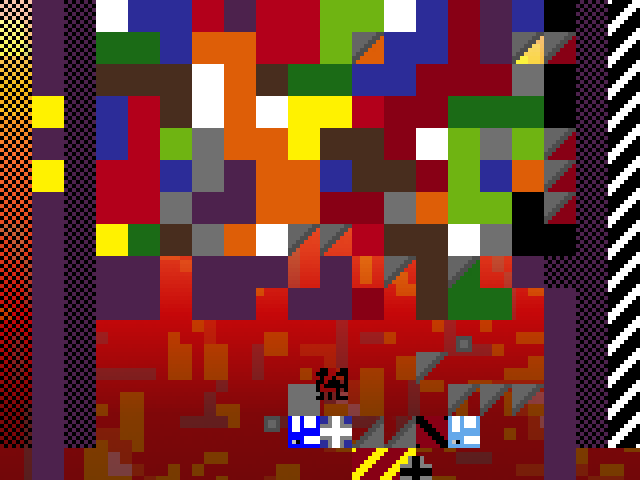
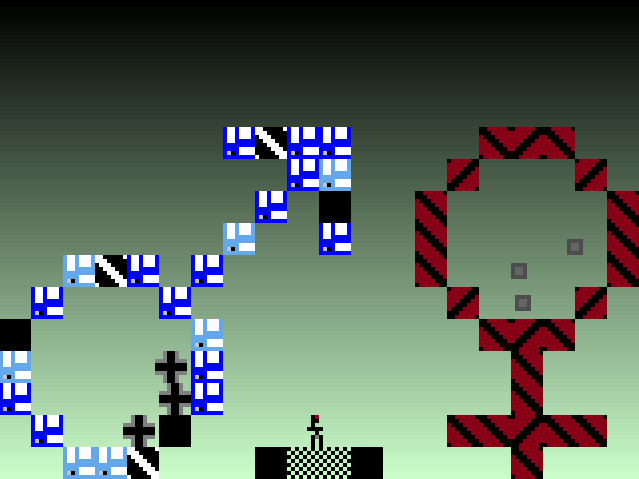
Problem Attic is a game about prisons, both real and imaginary. it was originally for ludum dare #26, then i took the idea a lot further. you can play it HERE MIRROR HERE (the mirror is recommended esp if you're getting super slow downloads). if you're only seeing a purple screen for awhile when you open the file it's because stencyl is dumb - but rest assured, the game is loading.

it's a 2d platformer made in flash (with stencyl) and takes 1-2 hours to complete (OR MUCH LONGER DEPENDING ON HOW LONG YOU TAKE I DUNNO). it runs in your web browser. the game will save your progress, but it will start you off at the title screen each time.

note: if you reach a screen that you think is the ending but you're not sure, you're not at the end. you haven't reached the ending until the game literally tells you it's the "end" =)

controls:

arrow keys to move
UPDATED 6/30: z or up to jump
r to ??
x to start

if you played the original ludum dare version, note that this game is kind of a different beast now and a lot of the control issues have been fixed.

the soundtrack will be forthcoming on my bandcamp page in the next few weeks. in the meantime, you can help me out and show your appreciation by getting my album SCRAPS, which is pay what you want.

enjoy!

- liz

Thursday, May 16, 2013

SCRAPS: an album of bits and pieces and pits and bieces


a couple days ago, on a whim i decided to put together a bunch of old bits and pieces of old music projects i had floating around on my hard drive for years into some sort of cryptic, grabbag-type format. i named it SCRAPS. for more details and discussion on why i chose to do this, see my tweets here:


i've been extremely frustrated and creatively congested for many many years, musically. i've felt like it was all building up to something, but i've put so much pressure on myself that it's never happened. hopefully doing this will alleviate some of that pressure. feel free to send to signal boost and send it friends and stuff, because it would really help me to get more exposure for this.

the album is 43 tracks and 67 minutes long. there are no guarantees of quality or consistency, but that's just part of the experience. things range from back in 2002 to stuff i literally just added yesterday. some are arrangements of videogame music from my ocremix days. there are also things in here with my pre-transition singing voice that i am very uncomfortable with, but i'm dealing with it.

the track titles are somewhat cryptic bits of ascii art i made to fit my feelings about the music in them in one way or another. possibly the best way to listen is to click on ones at random - then it becomes a sort of an exploration game. i even have been thinking of making a twine game for this album that better encapsulates this concept, but we'll see how that goes.

on the periphery of this is also my Actual Old Songs album Live Active Cultures, which i've hated for many years...but might be coming back around to these days. give it some of your love too, if you can - it desperately needs it.

the album is pay what you want, and i would really appreciate anything anyone can contribute.

i'll give you all a starting point into the cryptic world of SCRAPS. here's a cleaned-up version of an old arrangement of "terra" and "awakening" from Final Fantasy 6:


please share & enjoy!

Wednesday, May 8, 2013

an in-depth response to darius kazemi's "fuck videogames"


Darius Kazemi's recent piece "Fuck Videogames" talks about how videogames are not necessarily a medium suited for expressing all the sorts of things we'd like to use them for. Ian Bogost summarizes the aim of this piece in his short response:

  1. It's not necessarily more "noble" or whatever to express something in videogame form, particularly if it's not working for you.
  2. Often expressing something with videogames primarily serves a meta-rhetorical purpose or benefit ("Look, X made a game about Y"), which might actually detract from or even reverse the desired expression.
  3. Often the desire to express something with videogames is really just a desire to gain approval from a particular audience associated with videogames (he uses Twine games as an example), which may or may not be a valid goal but it's wrong to bind it to videogame expression.

an issue that i see underlying the whole piece that is never really expressed explicitly - it's the case with many "gamers" and techies in general that so many who have constructed their lives and identities through videogames often have a hard time accepting that there are other valid means of expressing or legitimizing their own emotions outside of technology. the world of technology is, after all, what they know. they want to make personal videogames because they understand how videogames work (having played them a lot) and that they can express deep emotions through play, but they don't have the kind corresponding experience with other forms of art to understand how those work. this lack of understanding combined with videogames' newness means they get raised to the top of the pantheon as the all-encompassing, clearly superior, art-form-to-end-all-art-forms.

and that defines conversations among people passionate about games more than anything else - a spirit of "we can do anything with games". one that can take on a socially progressive angle, but is often really driven by the same ultra-capitalist, highly fascist idea of tech culture's that humankind can overcome any kind of obstacles facing it through better technological products - or building more "perfect" systems.

but let's talk about points 2 & 3 of Bogost's summary in more detail. here's a direct quote from Kazemi's piece:

"Some people make games because games are cool, or sexy...if you write a blog post about your cat, probably nobody will care. But if you make a GAME about your cat, it’ll get covered on a blog or something!"


i love Twine. it has plenty of issues, but it is a very accessible tool that has allowed many to make games who would otherwise not have the patience or understanding for it. this is a good thing. i have mostly avoided doing my own Twine games, though, because if i usually feel like if i want to write something personal, i'd rather just do it here on my blog - instead of presenting players with some vaguely game-like, and ultimately not very meaningful set of choices. plenty Twine games don't do this - but it's always a danger of making games in that (or any other) format.

making a Twine game does not divorce you from all of the trappings of videogame culture and substitute it with something more pure, and it certainly doesn't absolve you of artistic responsibility as the creator. using a Twine game as a way to write about your own personal experiences doesn't absolve you of artistic responsibility, either. a game, like any piece of art, is a subjective window to reality - not reality itself. presentation is always the key, and it always defines how others will interpret and respond to your experience.

a lot of people also make Twine games as a social activity, and to have their experiences accepted and legitimized by others. and that's alright, but i find it highly peculiar that it seems to be treated as a somehow more momentous or more deep medium to express one's own emotions.

we are a culture that defines itself through words. the "important works of art" we're exposed to in school are novels, and maybe poetry. we inherently value words as way more deeper and insightful signifiers of meaning than images or sounds. anything that doesn't fit into that way of thinking is either treated with suspicion, or seen as vague, or strange, or manipulative, or incomprehensible, or frivolous. and i think this is a toxic idea. it is very easy to wrap oneself up in a cloud of words, or to build a tower out of them, convinced their ultimate rightness and trueness. but there is nothing inherently more right and true about words - in fact, they often serve to obscure meanings much more intuitively communicated through images or sounds.

Twine games - and "personal" games in general, of course, can be a great avenue for fostering empathy, and letting us explore aspects of ourselves and others we couldn't otherwise. but they're only one avenue.

i worry that we're more used to connecting with systems in videogames than with people. we tend to have trouble understanding how to make choices unless they are presented in a game-like manner. so we're using these games as a way to better understand ourselves and others through a way that we can connect with. and that's not necessarily a bad thing at all. but games are often not the best mirrors, either - particularly when creators aren't very thoughtful about the choices they provide their players. it's easy to misrepresent personal experiences in all kinds of awkward and manipulative ways and undermine your ultimate goals.

i have to admit - "personal" games have been a real thorn in my side. i did the music for Dys4ia, a game i love by a game designer (and human being) i love that has done many wonderful things for many people. but i don't know if critics would've understood at all what the game was communicating if the text wasn't there to tell them exactly what each little minigame was about. and maybe that's underestimating their intelligence, but i haven't given much reason to suspect that most critics have any ability or desire to comprehend subtlety in the thing they're experiencing either.

i am extremely skeptical that making an on-the-surface "personal" game is an inherently more valid or emotionally honest way to express oneself. i have seen too many times where clueless critics only construct meaning of works of artists as either a form of political protest or some kind of evocation of personal demons. these are the two pre-baked avenues allowed artists in a society that doesn't really understand or value artistic expression very highly.

in an effort to expand the expressive and empathetic range of the medium i feel like we've made a mistake in what we've chosen to highlight the most. to put it another way: i am tired of the lazy way we talk about these games. i'm starting to feel like i won't be taken seriously unless i make a game that is viewed as "serious" or as "personal". i am starting to feel like unless i say my game is "about rape" or "about transphobia" or "about misogyny" (three things i know a lot about) and clearly articulate why this is the case, that i won't be taken seriously. i must be trying to achieve some kind of articulable political goal, and/or the things featured in the game must be "my" experiences. otherwise, i'm just making another stupid cartoony videogame.

"Buying into the idea that validation can/should/will come from a given culture is way more nourishing to that culture than it is to you."


let's not beat around the bush: the culture around "indie" games is classist and racist as hell. yes, i said it. those who have the most access have the time and money get to control the distribution and the conversation for everyone else. they also get to run the events and choose what gets talked about at those events. we may try to do all we can to fight against this and subvert it, but they're still controlling the outlets for discussion in the end. major events happen in places like the SF bay area, or NYC, or LA, etc etc - these are where the real connections are made and relationships are built. if you're not around at events like GDC networking and meeting new people (because, let's say, you can't afford them), then you probably won't be taken very seriously or have access to many resources.

people trust people they know. i know this because i've experienced it firsthand. any degree of success or exposure i've had has been a direct result of the people i've surrounded myself with after moving to the bay area. and i'm privileged for that.

the more i've gone to events and met new people, the more i've begun to realize that everyone in this community knows everyone else. and i find that incredibly disturbing. why? because it means we, as participants in this culture lack the ability to be critical of ourselves - because we don't want to hurt our friends' feelings. once you start to greatly prioritize their needs above the needs of people you don't know, you stop becoming critical of yourself and the people around you. and this leads to cliques and increasingly greater and greater conflicts of interest.

one high-profile example that most people know about: Brandon Boyer, chairman of the IGF is friends with Phil Fish, whose game Fez won the overall award in the IGF in 2012, despite having already won an award back in 2008. and yes, i have interacted with Brandon a bit and have seen that he is a swell guy in many ways who cares about a lot of important stuff. and Brandon is no means the only person in this position. i've seen many journalists become close friends with their subjects. but with a lot of power comes a lot of responsibility. being a nice person doesn't mean that he has the ability to take on his friends to do what is needed in that situation. because he hasn't shown that he does.

and yes, i understand that artists tend to connect with like-minded artists. the internet assists greatly in bringing us all together. and the world around "indie" games and thereabouts is a small one as it is. i know that it's inevitable that many of us will make friends with each other. but i don't think it's a desirable situation for everyone to be friends with everyone else. why? because i don't think there are any adequate incentives for people to be critical of their own friends.

i certainly don't need to be friends with everyone. i already feel like i'm stretching myself thin a lot of the time, and i constantly worry about hurting other people's feelings with my opinions. the bay area is a wonderful place in many ways, but i don't think everyone should move here either.

i want to see all kinds of people who are not in positions of privilege, who are poor and non-white, who live nowhere near the power centers of this world do vastly more insightful and interesting things than anything i or my friends could come up with. i know this is very possible, or at the very least, is desperately needed. a vaster breadth of culture would certainly help save us from the increasingly narrow western frontier of highlighting expressive innovations in games built around new mechanics and novel subjects. we're not really respecting these games, as it is. they're ultimately treated as objects for us to feel better about ourselves as self-respecting educated white people who like videogames. they're monuments to a medium we still think of as ultimately stupid and immature.

the worst part is that we secretly don't even like them that much anyway. we say we love Cart Life but we don't actually want to play it. it's just there to make us feel good. we'd much rather sink our teeth into some flashy, mass-marketed sludge by an egomaniacal dilettante.