Showing posts with label games journalism. Show all posts

Tuesday, January 19, 2016

The Beginner's Guide and Videogame Criticism's Awkward Baby Steps

(obvious spoiler warning)

i didn't want to write about The Beginner's Guide, at least not publicly. while i don't know its creator Davey Wreden extremely well, i have talked to him a bit over the past several years about various life things and generally appreciate his openness with the struggles of being thrust into the realm of indie game celebrity from the success of his previous game The Stanley Parable when he was not at all psychologically prepared for it. in a scene which often privileges social currency above all else, and is filled with many friendships based mostly on utility, it was refreshing to see someone who's in the center of all of this open up about it, at least to some degree. i intended to email him my thoughts on this game because i talked to him about it at GDC last year and i thought that might be better to show my appreciation privately than posting something which may or may not be interpreted as scoring points off him or his work (like pretty much all criticism in the game world these days is or could be misinterpreted by people out there as doing). but then i also think about how i'm maybe affording him a lot of empathy i'm not affording myself enough of, especially now that the game is out there and launched much critical discussion.

while observing the game criticism sphere blow up with thinkpieces on the game a few months ago, i was pretty content to not join, even to respond to Ben Gabriel's piece which referenced many of those pieces while bringing up a parallel between Problem Attic and The Beginner's Guide i hadn't considered while playing it. Gabriel says:

The most obvious connection between Problem Attic and The Beginner's Guide is that the former is "a game about prisons, both real and imaginary" (the creator's description) while The Beginner's Guide is a game about a designer who makes games about prisons (at least some of the time) that are aggressively interpreted at the player as both real and imaginary.

i'm not interested in simply parroting an argument which states my game (Problem Attic) did a better job of conveying certain ideas than Davey's did, but i have to admit this parallel was amusing to me. when our fictionalized narrator version of Davey in The Beginner's Guide says he completely lost track of his fictionalized game-developer friend coda, in coda's very last game Davey presents to us towards the end of Beginner's Guide - an impenetrable, cold, dark, gigantic geometric structure - i thought for the first time that this was something that i might actually want to make. while the Davey of the narration said he felt more alienated than ever, i started to feel for the first time like i got a sense of who coda actually was. for me it hinted at a deeper truth not really observed in the game itself, acknowledging something that Davey was very afraid of. while Davey said he never understood why coda liked to make games about prisons, that topic is something i'm very fascinated with. this allowed me to easily put myself into coda's place.

but it's important here to note that both characters in The Beginner's Guide are easy to project yourself onto (as many out there have done). i also saw myself as much in Davey at times as i did in coda. i have both felt largely misunderstood by a lot of well-meaning but ultimately self-serving people as i have tried so hard to advocate for others' work that i've made it so much more about myself than anything they ever might have wanted me to do for them. both coda and Davey are archetypes -  Davey might be seen to embody a privileged white cis male who is used to seeing his perspective echoed in everything and coda a person without much of this privilege who is trying to challenge the notions Davey builds his foundations on - just as much as they might represent actual people. and so many out there seem to have missed this very basic point.

The Beginner's Guide is a deeply personal game, and the kind of personal distress it captures makes it also seem disinterested in having easy conclusions be made about it. Laura Hudson calls it "a game that doesn't want to be written about". Both Heather Alexandra and Chris Franklin talk in their videos about their difficulty plunging into the nuances of The Beginner's Guide's narrative. carrying on nuanced conversations about a piece of work has been a thorn in the paw of game criticism for years and its extremely rare for something so multi-faceted to have the visibility The Beginner's Guide has had. perhaps this might also explain why one prominent game writer sincerely suggested coda was literally a real person Davey was stealing work from and selling - this writer is part of a larger group of games writers who have not ever been forced to read or consider art beyond its stated intentions before. The Beginner's Guide forces this process on its audience, many of whom are dealing with it for the first time, and for that i appreciate it.

the obvious mistake the Davey of the Beginner's Guide makes, in the game's fated twist, is to try to read a human being's life into a work when he's much better served reading what that work might be trying to communicate more abstractly. in a larger sense, it's also about his failure to see outside his own perspective and bubble of privilege. it's important to note that this doesn't make the kind of analysis he's trying to embark upon completely useless, however, just grossly misinformed in the way he's embarking upon it. Heather Alexandra, in her video, suggests that coda's mod of a Counterstrike map Davey presents to us at the very beginning of the game has no significance as a space and that narrator Davey is stretching by trying to find meaning in it when there's obviously nothing there to comment on. this, i think, is also misinformed - you can look at the space and see the subtle changes made to its Counterstrike shell as an attempt to de-familiarize one with an environment so overly familiar to its audience it's taken for granted. that is the point of public art installations, for example. art still needs interpreters - to disseminate it, to help it be recognized - but not nearly as much as the interpreters need art - often to legitimize themselves as people, their identities, their practice, and their careers. still, Davey's impulse to interpret and explain coda's work is probably a sincere one, even if it's coming from a bad place. while his obsession with the person behind the work dramatizes the grotesque elevation of the individual practiced by Western culture, as celebrity or mystical object or scapegoat - one that is especially relevant in videogames post-Indie Game: The Movie, it's still not altogether completely useless. while critics like Chris Franklin self-deprecatingly acknowledge this is something they've also done before, we can still at least see this impulse to understand the work as some kind of genuine one (even if misinformed).


======


this brings me back to Ben Gabriel's assertion: "Everything worth attending to in The Beginner's Guide is handled better in Problem Attic". Gabriel argues that while it's true that you can say the nature of Problem Attic's design pushes its player towards understanding its central narrative themes, it also doesn't matter to say this for anything outside conversations where that kind of approach to game design is seen as a valuable marker of quality (embodied by conversations of the past several years around various kinds of "empathy games").

i think it's a good point to ask - is an experience a game provides interesting enough, in itself, outside of it being 'about' something? videogames, more than any other media, are slippery beasts that seem to perpetually confound and subvert the wills of their interpreters. the more that we fuss on what a work is 'about', the more each nuance of the actual experience tends to slip through our fingertips. but that's also not to discount that it's not possible to talk of what a work may be 'about' or represent in some way - it certainly is. but that conversation should happen in a way that's open to a multitude of different interpretations and lenses, and different experiences and perspectives - which discussion around art so rarely is. we must allow ourselves to be open to all potentially contradictory details of an experience if we can really hope to understand the deeper truths that piece of work might represent - not to try to be the carrier of the One True Reading of a work which comes from a place and context we can never hope to know fully. this is what Susan Sontag's essay "Against Interpretation", which Gabriel invokes, rails against. the One True Realities privileged Davey might need to invent in coda's work to feel good about himself break apart to a level of subjectivity and complexity Davey's not capable of making sense of from his position.

The Beginner's Guide, then, maybe represents the discourse around videogames' first awkward baby steps into the realm of taking on complexities in art. it also could represent the more mainstream videogame culture's first foray in trying to actually make sense of their position of privilege.

while this central theme - of a piece of work confounding and subverting the will of its hapless interpreter - is explored in The Beginner's Guide, there's still something missing here that we don't see. the matter-of-fact presentation of coda's Source engine games hide unsettling realities creeping under the surface. coda's games may or may not purport to be struggling with issues of communication and loneliness, but they only do so mostly via surface signifiers. you wander around hazy islands - the islands represent scattered thoughts and lack of confidence according to Davey. you're on the stage of a crowded theater talking to someone who is too anxious to act - then the game bars you away from that theater, Davey says representing social anxiety. you're on a ship that is about to crash and you have to perform the correct series of actions to not die - representing trying to come down from a panic attack, according to Davey.

we might leave all the misunderstanding and misreading up to Davey's narration - but then if we turn off all the narration, as Gabriel suggests, we can see more clearly that these works are mostly one-dimensional and present their ideas in a fairly conventional and marketable package - through slick, professional-feeling 3D structures and textures with little bits of quirk thrown in and standard WASD first-person movement. these games definitely don't seem like the first experiments of a new game designer, but someone who's been hardened by the craft of a particular sort of design practice attempting to branch out a little bit. these works might be a bit novel but largely don't subvert their package very much, merely embody them as confused and contradictory pieces of art that can never completely escape their Source mod shell. in the end they're maybe not bad but also not terribly unique as experiments in themselves, outside of Davey's framing of them.

and then it becomes important to say - not only might coda not represent a real person, but coda might just be a reflection of Davey himself. specifically the aspect of himself that he may not understand - his own pain that he's crudely trying and failing to represent to the best of abilities. his imagining of coda's Source engine constructs seem to reflect the kind of game culture commentary on games that the real Davey addressed in The Stanley Parable, and the culture of the Source engine mods he came out of, much more than decisions made purely for artistic reasons. even the real Davey seemingly can't escape his own perspective. while all of coda's games are presented in a fairly conventionally-polished package, games like those featured in the catamites' 50 Short Games compilation are much more sketchy, hand-drawn, cartoony, abstract, hard to pin down explicit meaning or intent in. the catamites's games, or increpare's games (which i find the most similar to the kinds of games coda is making) challenge players not just with novel approaches to narrative but also in their presentations and framing. the fact that they work on more dimensions makes them harder to talk about than the works in The Beginner's Guide - they often problematize the centering of the mainstream white cis male voice in games much more explicitly, for example - which just adds to the feeling that we're only seeing a more one-dimensional, neutered, still fundamentally unenlightened presentation of those kind of games here.

a friend suggested to me that is possibly why the game is called The Beginner's Guide - it's a more palatable window into taking on the more difficult (but ultimately more rewarding work) of game designers like increpare. but, if so, the game actively contradicts itself by calling into question its own method of analysis by the end, leaving the player to question how effective any of this really was.


The Beginner's Guide says - i tried to make this thing for you and instead i just used it as an excuse to hurt myself. the Davey in the game recognizes this is all really about him in the end and panics, in much the same way real Davey might have upon receiving the criticism that the fictional works of coda seem to have a lot more to do with him than anyone else he might be advocating for. it shows a level of self-awareness that is unusual and maybe admirable, at least for this sort of game - but still leaves us behind feeling unsatisfied, like we don't really know where we've ended up after all of this. while narrator Davey's analysis is self-serving and one-dimensional, his self-destructive freak out at the end of the game is equally as self-serving and one-dimensional. he's still centering himself in coda's story, assuming coda has come to hate him in a way that may or may not be true but probably doesn't represent the full reality of what's really going on behind the surface. so we're left feeling like there's a story there that's never really told, and we're only ever seeing Davey's side. he freaks out when it comes time to acknowledge his position of privilege and lack of perspective without ever taking us away from his world. his freak out feels like just that - a freak out, one that we're left to do the work pick up the pieces from. it's like we still have to comfort Davey, in a way. the wordless ending after all of this is over maybe suggests a possible escape or transcendence outside the bounds of the level - and Davey's own perspective, perhaps into the realms explored in games like Problem Attic or Corrypt, but it's left only as a fleeting thought for those games to address. Davey is not capable of doing that work himself.

i admire The Beginner's Guide in some ways for existing in the context it does - for inspiring the discussion it has - for implicating (at least in some ways) one-dimensional, self-centered criticism of videogames and art in general - and for being a deeply personal work which honestly exposes the anxieties of its creator. but i have to feel like in the end, Davey's freak out leaves him no closer to understanding what's truly wrong about his perspective - or truth of his privilege - or that real answers Davey seeks are contained much more in the other, more radical works i've mentioned - the increpares, catamites, Nathalie Lawheads, the altgames - the ones the ending perhaps points to, the ones that challenge game culture in the way this game fundamentally doesn't. the ones that most game critics are afraid of taking on and trying to make sense of because in the end they might just dismiss the authors, as Davey does so often with coda, as being "depressed". The Beginner's Guide, like most critics, needs those kinds of games much more than it will ever acknowledge - and far more than those kind of games will ever need it.


(as always, this post was made possible by your support on my Patreon. thank you!)

Friday, December 19, 2014

On "Comprehensive Game Criticism" and Plastic Ghosts of the Past


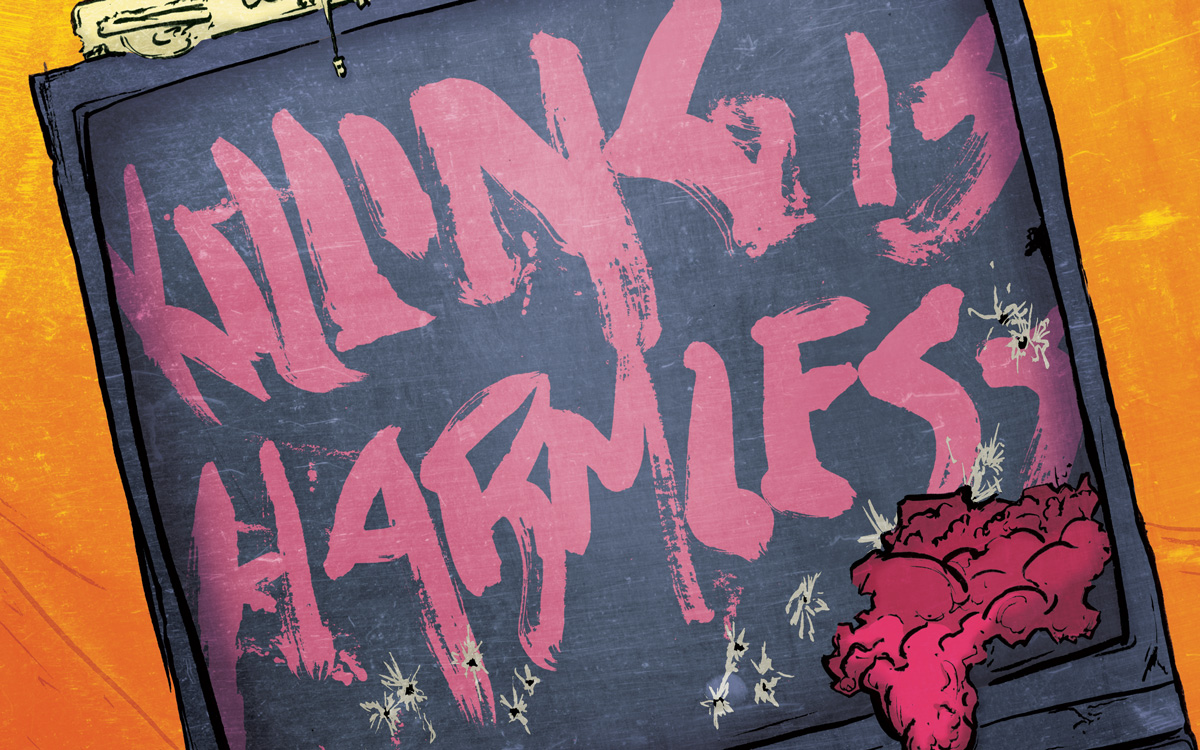
"we need more comprehensive game criticism" is something i remember seeing a lot of people say on the twittersphere a couple years ago, partly in response to me writing some of my Wolfenstein 3D level design posts. mostly this call seemed to come from dudes who were really into first person shooters. as such, i was already skeptical that they even really understood what i was trying to get at in the first place. this was not about looking like a "serious critic" or raising videogames' cultural clout, just offering some new ways of looking at something strange from the past that interested me. Brendan Keogh's Killing is Harmless seemed to embody the exact opposite of the kind of criticism that i wanted to do - something that fetishized details in the story or game world while willfully ignoring admitting to the bigger picture. the point was to be acutely aware of all the shortcomings while still giving respect to the stranger and more resilient parts of a game, not to pick for little details until i've created an interpretation that i can disregard the overall experience with completely.

ok, i admit that i generally feel anxiety about writing nuts and bolts criticism of things like level design because it never really seems to appeal to anyone outside of a niche audience - namely, people who are fans who are already intimately familiar with the source material, or other game designers. and videogame insularity has become increasingly tired and boring to me.

not to mention writing this kind of stuff gets you immediately lumped in with all other writing of this kind done of the past, even if it's only vaguely related. the biggest problem with many of the level design critiques i've read online is how undiscerning they generally are, and how unwilling they are at interrogating decisions made in the games as anything other than examples of "good design" or "realism" or "atmosphere" or any other vague concept that usually never gets articulated. there's generally no real point of view in the analysis beyond a bunch prescriptive, cliched assumptions you've heard a million times before. detailed game analysis usually just serves the purpose of reaffirming the status quo, through the old traditional (and highly stale) modes of thinking about games.

fact is, videogames have that ineffable "magic" thing for its players, that thing that makes its faithful start to tear up when they think about those grand old game campaigns they took part of. that thing that makes them think they are greater. that make us think we can fix everything. well okay, only if we're the type who hasn't had very many experiences outside of them. but nevermind the outside world, it's about the games, man. it's about the technology. that's the magic key that'll fix everything. we say this as people on the outside watch as we continue to stare endlessly fascinated into these unchanging flat computer-generated approximations of crystals on the TV screen, wondering what's so hypnotizing about it all. and when we can't come up with any new or more decent argument about why we keep staring so intently, it sure doesn't make us look like we know what we're talking about.

the presence of things like level design pieces all end up just feeding back into the same kind of nostalgia tourism - it's a curiosity. it's not the kind of writing we're doing regularly these days. it's boring, it's "necessary", it's a chore, but it's not something that feels altogether very relevant. broad generalizing statements about game culture are in, nuts and bolts are out. maybe a big reason for that is because people doing nuts and bolts writing don't know how to make it feel relevant to the current cultural climate. or maybe it's because most people still just don't really respect games that much. maybe they still have a good reason for that.

===========


i never really expected that i'd be writing anything about Perfect Dark. Goldeneye is much more memorable to me now - it's more streamlined, and much better evokes the feeling of freedom that comes from old smeary lo-res 3d geometry and elegant compromises that arise from awkward technological limitations. on the contrary, it's hard for me to even think about Perfect Dark without thinking of slow framerate and awkward aiming with the N64 controller; or the bizarrely long insta-fail missions with equally bizarre and cryptic mission objectives. strange that so many resources got poured into making something on a system that seemed to be fighting it every step of the way.

the first word that comes to mind when i think of Perfect Dark: "bloated". it wants everything, it awkwardly grasps at achieving more robust and serious and weighty storytelling than its predecessors, yet its still unhappily caged within its smeary, lo-res plastic shell. it's also highly hypocritical, game design-wise. you have detailed mission objectives to follow, you have voice acted cutscenes, it seems like you should understand how to proceed intuitively but things are still not really clearly communicated. often it seems like the game is punishing you for no real reason, just MISSION FAILED because you didn't insert an item correctly into the right slot. and this might be interesting if it felt in any real way intentional. it mostly just feels stressful and tense, and like the game wants you to conform to its arbitrary and quite frankly poorly-conceived design to proceed. the Goldeneye-esque no save point missions make even less sense here, as they are much longer and harder and full of bizarre details you must keep track of. it just seems like that format was imported unthinkingly, without much attention paid to how it affected the game.

yet if you look past the game constantly hitting you over the head for not meeting its largely un-telegraphed expectations, there are still some moments of beauty in there. i guess that's what Zolani Stewart senses in his "Let's Crit" videos of Perfect Dark. there are spaces in between the bloat that manage a kind of levity, that feel very intentionally constructed.

Zolani eschews some of the usual prescriptive analysis and mostly tries to focus on the game's strangeness. he talks about how Perfect Dark oscillates between being disorienting in its design in an interesting way, and just being obscure in a bad way. he also asserts that Perfect Dark isn't really a shooter, or really best looked at as a shooter anyway, but instead is more interesting as a place to explore strange spaces. i would be less generous, as a lot of the spaces often aren't really strange in an interesting way, just awkward series of hallways that add nothing to the missions at hand other than adding a more "realistic" or robust feel, and as such feel antiquated in a way that something like Mario 64 with more overtly abstracted spaces don't. i will say they do feel much more alive with detail and colorful than Goldeneye, though. their range certainly isn't something i've seen attempted in similar kinds of titles.

it generally feels like he's letting some nostalgia tint the game in a softer light. i mostly can't agree with him on Perfect Dark not being a shooter either, for example, as the game does try to reassure you pretty consistently that it is a shooter, often throwing an absurd amount of guards to shoot as meatwalls to your progress. i will agree with him in part, however - the variety and construction of environments, particularly some of the Area 51 levels, or the final Skedar level, does achieve a sort of abstract but highly detailed sense of place you definitely don't see in games these days. and the juxtaposition of these environments with all the bizarre requirements thrust upon you give Perfect Dark a feeling unlike other games, for better or for worse.

=============


but let's compare and contrast. my favorite Goldeneye mission is called "Surface 2". a snowfield thoroughly shrouded in a disturbing red fog. it's like a bad omen swept over Surface 1 (an earlier level)'s bright snowy fields. there are more security cameras planted on buildings that and lots of enemies will wander in and out from your view, but both the fog and the N64 limitations make it difficult to make either of these things out until you're really close to them. even the indoors are shrouded in this dark fog. inside a big satellite building (still seemingly shrouded in the same red fog) where you previously had to shut down a satellite dish in Surface 1, you now have to blow it up. hitting B will just cause you to activate it, failing the mission. no remorse. just a big feeling of evil.

or Statue - a graveyard of abstract geometry filled with smudgy greys and brownish greens, and shapes you only half-make out, and sometimes unwittingly get stuck on. the actual design of the map is linear and feels too long for what it is, especially when there are plenty of places to get lost in which becomes especially infuriating as you have to run back through with a time limit and shotgun guards are flooding in. it's like a disturbing train ride into a deep and dark part of James Bond's past. looking back there's something bizarrely beautiful and singular about it.

both of these missions precede your character getting captured and held prisoner in the next mission. it's as if these missions exist as a dark omen clouding over the rest of your story.

the closest parallel in Perfect Dark is the "Chicago" mission (Zolani also acknowledges this as well in his video on the level). you're in a Blade Runner-esque perpetually raining neon cityscape at night, except it's only a block of a cityscape. and you can't even enter any of the buildings (except as an Easter egg), they're just a weird-looking backdrop. as a piece of grand ambitious realism this mission fails. but somehow the little world in it also feels a lot more robust and dangerous than other missions in PD. FBI spies that will report you that look nearly identical to civilians you're not supposed to kill, which almost seem to outnumber the actual guards in the level. also there's a security drone wandering up and down the block that somehow knows who you and you alone are and will start shooting with lasers and shout "STOP WHERE YOU ARE" in a scary robot voice when it sees you. when trying to remember details of mission, the robot felt like such a strange part that i thought i must have made it up completely.

the mission objectives also don't seem to make much sense and force you in uncomfortable and awkward positions, like a taxi you have to scan for several seconds to create a diversion that happens to be right in the street where the robot patrols. but because of all the elements at play there, there's a palpable feeling of tension to the mission. because the environment is small you can visualize it and develop strategies for how to deal with it. the feeling of anxiety and lack of control you experience feels very intentional and fitting for a futuristic dystopia, not arbitrary like other missions.

and i mean, i can still think to the aforementioned hallways of Area 51 which kind of have a lost, forlorn feel to them even as they're populated by guards or annoying drone guns. or the aforementioned final Skedar mission, which is highly linear but has a much stronger and more unique sense of place clearly constructed to work within the limitations of N64 hardware than anything else in the game - and also features very tense fights with the Skedar aliens. their different anatomy and behavior make for a much more entertaining enemy to fight than the same old meatwall guards. these environments work when they work in tandem with, and not against, other elements of the game.

contrast that with a mission like Air Force One, which is filled with awkward hallways, triggered story events and empty dead-end rooms. the level certainly looks a lot more like the actual Air Force One might look like, but not really to its benefit. or the Pelagic II, which is just a series of pretty but boring hallways. or the even more generic green alien hallways of Deep Sea. or even the Carrington Villa, which might be a fun place to explore if the game ever let you and meaningfully interact with anything else in the environment aside from shooting guards. the game often seems afraid of its abstraction, desperately grabbing for more detail and gravitas to lift it out of its abstract, formless shell. it has to be a shooter, it has to try and justify itself to you, it has to be taken seriously. it's an awkward adolescent, trying to do so much more without understanding what made it work in the first place.

mostly (and rather unsurprisingly) Perfect Dark just feels like a combination of half-realized ideas with mixed levels of execution made within the genre limitations of a FPS game made in the late 90's. it's sad, but beyond that, i don't know if there's really anything else to say about it

=============


Goldeneye was regarded by its development team as a crappy licensed game until its surprise success. by contrast, Perfect Dark was hyper-ambitious, hyper-resourced, hyper-followed by eager fans.

around 2007 i remember sadly peering through the glass case in a corner at my local videogame store that contained the N64 cartridges. there was something sterile and empty feeling about all of them. all the life and possibility that sparked within me from seeing N64 games when they were new seemed all but left behind, only their husks remaining, like little ghosts. still, i remember seeing Mario 64 sitting gleaming at the top of the pile, or an occasional copy of the original Super Smash Bros that would usually quickly disappear. and then there were the multiple copies of Perfect Dark sitting at the bottom, all labeled for 5 dollars. it was almost eerie.

i spent a whole summer with Perfect Dark back in 2000 when i was young, and a whole year prior to its release on Perfect Dark forums feverishly checking for any new info about the game that i could. it seemed like something i could get really lost in. it was the newest, greatest, biggest experience. but now all that content, all that time and energy, all that had built up to the release, was now sitting at the bottom of the shelf in its plastic grey shell for 5 dollars. the newest and greatest never seems to be as new or great the second time around. that bloated, awkward monster of compromises made just for us - the fans, now looks like nothing more than a little glimmer of the past. but now the fans are elsewhere. they've moved far, far beyond it. and meanwhile those grey shells are still somewhere at the bottom of the pile, collecting dust, sitting next to Madden 98, or Ridge Racer, or Turok: Dinosaur Hunter, or any number of other husks of disposable grey plastic that look just like it - all neatly sealed-off and lined up in a row, as if they were gravestones.


===============

(note: you can support my work on Patreon here: http://www.patreon.com/ellaguro)

Wednesday, September 3, 2014

On 'Gamers' And Identity

(this is, in part, a continuation of my "on right-wing videogame extremism" post from a couple weeks ago)

when i was in sixth grade, shortly after the Columbine shooting happened, i remember having a strange conversation with my mom. after seeing a report on TV, i said something like "i just don't understand why these school shootings...." before awkwardly trailing off, unsure what i was trying to say. she asked, completing my thought "you don't understand why they happen so often?" i paused briefly, thinking, and then replied "no, i don't understand why they don't happen all the time."

disillusionment was an everyday reality in rural Ohio, where i grew up. i felt it as a tremendously overwhelming truth, a constant feeling of being trapped in an infinite sea of identical houses, churches, fast food. this sea was constantly breeding fear and paranoia, and the communities that did exist here all seemed to be religious and usually relied on making members of their community feel terrible as possible. i didn't want to have anything to do with them. but there was a thing for someone like me, who wasn't very into Christianity and didn't feel very connected to her body and didn't want to damage it through drug use. you could easily find some connection to other people in the area through media and, in particular, videogames. i remember my deep, knowing nod when a friend's coworker at a bar in Ohio simply responded with "Mario 3" after i told him i liked videogames. it was this great universal truth i immediately understood. even in the biggest cultural wastelands, geek culture seems to flourish somewhere - through Magic: The Gathering tournaments or local game stores, even sometimes at places like Walmart. when there is nothing else to base your identity on or invest creative energy in, things like videogames easily become your life. they're a drug, the thing that keeps you going, feeling free, feeling connected to people, and feeling like you're someone.

being a "gamer" becomes your identity.

"'gamers' are over" is a sentiment i've seen circulated around a lot in the past week or so in response to the horrible misogyny and threats that have come out of this whole #gamergate thing, but i think it might just be talking around the heart of this issue. i don't blame anyone in the press or game devs for feeling unsafe, feeling angry and losing their patience, even quitting games. but the constant harping on gamers as 'entitled manbabies' (while perhaps true in one way) is just using the same old lazy language employed against games in popular culture and misses out a lot of the dynamics that are actually going on here. (not to mention calling them insane or deluded or deranged uses the same sort of tactics the harassers use on women). the disillusionment people on the gamergate hashtag people feel is real - one borne out of the industry's bloat and creative stagnancy, the sudden turns towards social consciousness in the media, a loss of a feeling of greater 'consensus' in game culture because of the splintering of media and, especially, feelings of inaccessibility into spaces that are now influencing game culture at large.

Cameron Kunzelman's frustrated conclusion after engaging with a #gamergate tweeter is telling: "It seems to me that the participants in #gamergate are all there for different reasons and that it is mostly an accidental coalition that has formed out of a sense of being wronged." the aforementioned long, rambling conversation between him and #gamergate tweeter Adam Haux which was mostly about game reviews, ended in this exchange:

many of us connected to games see many details #gamergaters have espoused about the connections between game journalists and game devs as comical (because of how little they understand how much everyone is actually connected), random, or arbitrary. this well-circulated graphic linked by Gameranx editor Ian Miles Cheong (supposedly from 4chan), for example, lists SJW (social justice warrior) game journalists to boycott. the reasoning behind this list seems arbitrary and to only have a surface awareness of what's happening, as there are women writers who have written socially-themed articles for those websites that are not included, whereas some other people on there might have never written any socially-themed articles for said websites at all, or have poor reputations for it (ala Ben Kuchera).

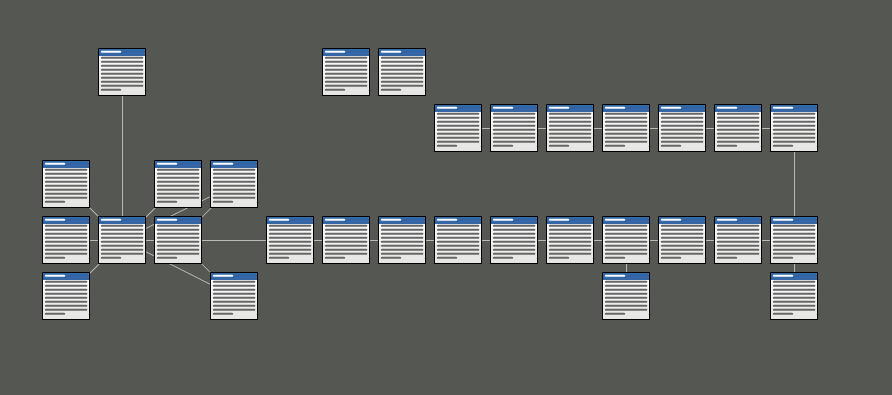
in this one (via Leigh Alexander, apparently taken from a #gamergate tweeter though i can't find the original source), people in the games press are linked together, often with barely tangential, small threads. some of the information on here is probably not true. i, for one, do not fund Jenn Frank on Patreon (but i might start!).


at heart of this mapping, however arbitrary, there is the idea that a group of people they have no real access to or influence with is changing videogame culture. this is, in fact, exactly what is happening. they may be ignoring the obvious, ever-present problems that continue to plague videogame culture and culture at large, like (male) friends hiring or awarding (other male) friends. or the persistent problems of inaccessibility and exclusion in indie game circles i've talked about in previous articles. or, even more present, the game industry's buying out of the press which has been a documented controversy for years (which Lana Polansky talks about in her recent piece on payola), most notably embodied in the Kane And Lynch review scandal from 2007, or how way the "Doritogate" controversy brought to light the "tragic, vuglar image" of game journalist's relationship with game companies of two years ago. these are real issues that have been affecting the industry for a long time, but they're not ones that this group seems to pay much attention to or care about.

instead, they're choosing to focus on deeply misogynistic conspiracy narratives of lone manipulative women or queer people using their sexual prowess to manipulate and define who gets recognition or awards. and these narratives are made even more bizarre with their intersections to much deeper and more pervasive conflicts of interest that veer hard right, seemingly for no logical reason, towards deep misogyny. many of these people, like the guy who made the above video, might be frustrated gamers rushing to take advantage of this whole controversy while it's still in the cultural consciousness and find an audience for themselves. women and LGBT people are the already strongly established outside interlopers to their culture, and slut-shaming and victim blaming are deeply ingrained past-times in the language of pop culture. so the sudden presence in the media is taken as the most obvious explanation.

however, as writer Daniel Joseph suggests in a tumblr post from over a year ago, there are other, more basic social tensions happening in all of this conflict:

"...videogames have become one of those 'spheres' that was supposed to separated from 'real life', which explains, once again, why 'gam3rz' are so virulent in their defense of sexism, separate spheres, border patrolling, racism etc. It’s that 'private sphere' that they shared with others which was conceived as their private garden, their summer cottage...

...The bourgeois class created the private because it had the resources to manufacture a world distinct from the aristocracy and the monarchy while the previous classes, farmers and serfs had no concept of the private. Think about how brands are supposed to be private - they are families you bring into your kingdom because they are lifestyles and ideas and whatnot embodied as subjects - even if those subjects are just commodities. Brands, rather than products, become citizens of sorts and are represented by their various manifestations in your private kingdom. 

...Remember, this separate sphere is all we have outside of work itself. It’s this private sphere that is supposed to lend true meaning to our lives - not our shitty job that we grudgingly wake up for every day. This is where shit matters and as it happens when things are under your care you give a lot of damns when something appears to attack them.

So what comes out isn’t so much entirely about a hatred of women (though much of it is) but also about the reaction against the drive of a more communal impulse to challenge that hegemony of the private sphere. To move against bourgeois values means to attack, in one sense, that autonomous sphere of production and reproduction of the monarchy of the home. It means to rip that tiny sphere of sovereignty that so many people, robbed of any other space of control in their lives through rampant capital accumulation, have. It also shows how the economic movements of our world come around and viciously react against things they seem so far away from."

in other words, #gamergaters are afraid that new progressive communal challenges to the one small private sphere of the home they've been socially permitted to exercise control over and feel freedom within will cause them to be erased. as such, "'gamers' are over" may sound more like a declaration of war to them than anything else. 

let's be honest - the industry has failed "gamers" because our culture has failed them. for me, being in a place like rural Ohio was so tremendously unempowering, and made me feel so much like i was so far from being able to ever influence the larger culture that i felt like i at least deserved the videogames everyone else i grew up around seemed to get to cope with all of it. that feeling, like you're "owed" media, is the default response of our culture to not being able to exercise any kind of other real autonomy or control over any other aspects of your life. critical personalities who cynically evaluate media from entitled perspectives like Yahtzee Croshaw or TotalBiscuit or JonTron, therefore, speak tremendously to these sense of values and shared culture. other popular media constantly reinforces and echoes these ideas until they become a phenomenon, a consensus, a way of looking at your existence, and when pushed, a venue of life and death.

i'm worried, as always, venturing into writing about this subject again. the problem is that those private gardens of videogames are no longer merely private gardens, but real, tangible territory with real causalities - where real harassment, doxxing, hacking, and violence happens. fantasizing about committing acts of violence on the people who you perceive to be the architects of your misery is one of our grotesque cultural pastimes, one that the culture of aggressively-masculine marketing around videogames has certainly only just added fuel of the fire of - one that's constantly enacted on the beings of the weak and marginalized.

and yes, i remember how ridiculous the rhetoric about violence in videogames around an event like Columbine was to me as a sixth grader, how they don't understand how abstracted and silly the violence in a game like Doom was, how it was all simulated, how little of a basic understanding they had of how games work. but as those debates have largely dissipated over the years, videogames have only become more violent, have only ventured much further into simulated realism meant to more convincingly substitute for a disappointing and dis-empowering reality, have only catered much more deeply and pervasively to the entitlements of their users, and have only become more ingrained and ever-present in culture. where we stand now, videogames have deeply entrenched themselves as the primary venue for dis-empowered people to elect themselves as servants and act out the sociopathic fantasies of the ruling class. videogames literally train soldiers. if you feel disillusioned, if you feel not particularly smart or skilled, videogames are there. no surprise, then, that this learned rhetoric is further blurring the lines between fantasy and reality and creating a battleground in such a seemingly arbitrary part of popular media. no surprise that this battleground is very real.

the problem is these violent impulses are self-destructive at their core. they're not actions of autonomous actors, they're culturally programmed. they're the impulses of a suicide bomber throwing himself into a crowd of people. they're deeply emotional, deeply disconnected, and deeply afraid of what's happening in the world - and that's what makes them scary, and very real. and that's why we need to see them for what they are - fear, and understand how and why they're deeply intertwined with our culture.

if we want this stuff to go away and stop being a problem, in whatever form it takes, then we need to be able to map the source of it, to provide context, and to understand that at some fundamental level we're all in this together.

Friday, August 22, 2014

On Right-Wing Videogame Extremism

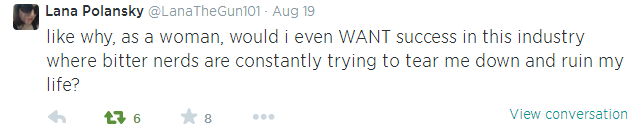
exhausted by hearing reports from people i'm acquaintances with of being harassed, their accounts hacked, personal info spread, phone numbers called, front doors showed up at (in one case) by random MRAs (Men's Rights Activists), 4channers, Redditors or whoever the fuck it is, i decided yesterday to finally look on 4chan for more insight what is actually going on. i share the fear with a lot of other women who work in the realm of games but have less exposure of what will inevitably happen from getting more exposure. a lot of us look to someone like Zoe Quinn or Anita Sarkeesian and the image of more cultural visibility is not exactly very appealing. living with no privacy is not appealing. living in fear for your personal safety all the time for doing what you want to do is not appealing. i have my whole life ahead of me. i'm still working through tons of issues with depression and anxiety. i don't want that to be ruined by a few people who can't get a fucking life and leave me alone. these couple tweets by game writers Lana Polansky and Patricia Hernandez pretty much sum it up:


just this evening, one or numerous people who presumably were going after Zoe have begun to target several indies who are her friends or acquaintances. and now several indies and anyone tangentially involved in the scene are are scrambling to two-factor authenticate their accounts, change passwords, and lock their twitters. there's a feeling that there's been a war declared on indies, especially social-justice focused ones, and a lot of people are afraid. at the time of writing, a twitter hashtag - #welovegamedevs, has recently just showed up in response to all of this. 

in a recent 4chan thread on /v/ (which was deleted), a picture of Phil Fish's homepage claiming to have been hacked by "a leader of Anonymous and head moderator of /v/" posted his bank account info and phone number and, among other things, said he was targeting other SJW (Social Justice Warrirors) and indie devs. the thread was filled with commenters proclaiming that Phil Fish must have been so desperate that he had faked it all himself, and that it could never be anyone from /v/ because there's no such thing as a head moderator there. i guess the possibility of someone intentionally writing inaccuracies as an inside joke and/or to convince more people on 4chan that it was faked didn't occur to them. the level of victim-blaming was pretty astounding to me to see - ESPECIALLY given that his personal bank account info was shared on the page. many posters seem desperate to take the blame away from 4chan and their complicity, all while still seeing no irony in their readily sharing of doxxed info. i guess even they didn't want to believe that people among their ranks were actually doing these things, because they knew it would only hurt what they see as their "cause".

so what exactly is their cause? from reading through several of the threads, it's not entirely easy to tell. 4chan is an intensely attention-deficit subworld that is known mostly for chaos with little accountability or sustained serious discussion. that's presumably its primary draw for a lot of people in the community. nonetheless, the best summary i got was from these two posts (click to enlarge):


the source of this latest, greatest internet shitstorm seems to all stem from a bitter, narcissistic, hyper-detailed tumblr post from an ex, Eron Gjoni, of Zoe's (search for "the Zoe post" if you really want to know, but you probably don't) which lays out in minute detail their relationship and posits that she slept with several different game journalists and game festival people for favorable coverage while in a relationship with him. regardless of what whether Zoe did was ethical or not, the post indifferently shares a frightening level of private details about their relationship and private IM and facebook conversations between him and Zoe, presenting it as "evidence". 

this post spawned several youtube videos invoking her sleeping around for favorable coverage as some kind of indie game/game journalism conspiracy, like this one (which to this date has 500,000+ views on youtube and a very good likes to dislikes ratio). John Brindle breaks down the twisted methodology of this video and others like it far better than i could in detail here (click to enlarge):


the full storify of his tweets is here. the most striking thing to me, beyond the bizarre level of arbitrary detail their relationship is documented in Gjoni's post (e.g. "I had my first panic attack Apr. 29th"), is that he uses the language of games and rules sets to intensely analyze the potential outcomes of situations he felt he was put in in their relationship. as John Brindle observed, the talk of puzzle pieces and investigation seem like some perverted version of the protagonist in the popular game Braid. they also recall the kind of universal strategies and "truths" about the opposite sex developed and disseminated by pick-up artists, but in a way they originate in game language - and game culture, in how games disembody and dehumanize subjects. 

unsurprising, then, that these gamers seem to have no problem taking the side of a bitter ex that seems, in no uncertain terms, set out to destroy her and bring as much harassment her way as possible (as it is now doing).

----------

so i'll admit - when i first heard about Depression Quest, i had a pretty mixed reaction. i was glad to see a more visible game examining serious issues that come with a thing like depression, and i knew enough about Zoe to know that she'd been sincerely and openly struggling with it. she has, in fact, claimed that making the game saved her life. but i was also skeptical because i felt like it was taking some of the more abstract themes of lots of personal Twine games that were being made around the time and branding them in a more universal, surface, mainstream way. "depression" is such a broad cultural concept that originates from any number of sources - the idea that it remains this inherently abstract, alien idea that must be navigated through and corrected doesn't let us deeper into the very real sources it usually stems from. the fact is, depression is unfortunately a pretty normalized way of life. we live in a world that heavily encourages people towards developing intense anxiety and mental illness. and so i felt like other games had looked more into the source of these issues from more interesting angles, but weren't being recognized by the culture because they weren't so aggressively marketed.

regardless of my misgivings, any situations that have since developed around this game have digressed so far beyond any of the game's original intentions and shortcomings and into a strange, terrifying sort of cultural battleground. something about Zoe in particular - maybe that her game was all of a sudden ubiquitous, maybe that she was a woman who openly and unapologetically shared her image online, maybe that she seemed to be everywhere, triggered the killswitch in the greater consciousness of this reactionary gamer contingent. and as such, Zoe has become the scapegoat for every bit of internalized misogyny and misdirected rage these people felt. she appears to them an amorphous assemblage of everything that is viewed as wrong with women - manipulativeness, sluttiness, being an 'attention-whore'. the idea of trusting the word of a frighteningly narcissistic ex who's out to ruin her reputation is fine with them, because it meshes with their worldview. suddenly they have a convenient situation that explains away all their disillusionment and misgivings with themselves and game culture. suddenly it's about all game culture at large and ethics in game journalism, as in this post:


that's not to say that there aren't some grains of truth in these criticisms. the indie scene is often cliquish and entitled. it does benefit you tremendously to know the right people, and there is a lot of incestuousness and possible conflicts of interest that come into play with game spaces, so it's not a huge stretch to make that criticism. but focusing on a boogeyman of this seemingly formless, evil master manipulator woman who uses any tools to her advantage to gain positive press and reviews (which, btw, never materialized in at least one case - Nathan Grayson, a Kotaku writer she allegedly slept with, never wrote a review of Depression Quest) says a whole lot more about fear of women than it does say anything about any of the (numerous) problems in game journalism and the indie scene. nevermind that so much industry coverage, even from their beloved youtubers, functions as glorified PR. the fact is, most game journalism is already tremendously confused and broken, and at a much bigger and more fundamental level that these people think this Zoe Quinn "scandal" is.

for one, my big criticism of this new indie culture - that it's an extension of tech culture and is ultimately product-driven despite it often grasping for another image, that it's not nearly as open to new people or new ideas as it wants to believe it is, that a lot of the interesting things that are going on in independent games (like a lot of free games by people like increpare and stuff on gamejolt or warpdoor or forest ambassador, for example) are not really recognized as part of the "scene" or given much of any coverage from mainstream outlets, that writers who do focus on devoting their time to looking at more interesting aspects are constantly marginalized and ignored inside and outside the scene, that a lot of what comes out of the visible indie scene just reflects the same triple-A, game industry values despite people purporting to be more progressive/feminist/whatever, is totally absent from these criticisms. these people don't really care about lack of recognition or coverage for interesting new games made by outsiders. they care about getting back this abstract, indefinable feeling of a shared culture created and fostered by corporate media that seems to have been lost to them. they are tremendously scared and frightened people. ironically given what they say about their targets as whiny and overemotional, they are far more irrational and overly emotional in their responses. they care only about acting out on their numerous emotional triggers in whatever way possible, and using whatever tools they can. they are tremendously paranoid.


one of the biggest sources of paranoia i took from reading through my first 4chan thread about this issue is that social justice activism will inevitably destroy communities like 4chan. these people feel so disempowered in their lives that they head to communities like 4chan or reddit to be able to feel some sort of empowerment, to act out on something, to feel part of something bigger. this is where the whole mythos of Anonymous comes from. that a lone person with a computer has a tremendous power to take down the shadowy elite. but in that act, there's no accountability, and no moral code. anyone with the resources can mobilize people to target anyone they see fit. sometimes it attacks against the interests of power, but just as often it's a conservative, reactionary anger that comes out of disillusionment and fear, and gets constantly externalized onto marginalized people, especially women and queer people. 

they struggle to understand and adjust to a rapidly shifting cultural landscape, in and out of games, that's moving away from traditionally catering to them and their empathy-deficient values into something more culturally sensitive and aware. and so they find simple explanations for these complex phenomena that fit within their bigoted worldviews - boogeymans of evil, manipulative and misleading women like Zoe Quinn or Anita Sarskeesian. they view themselves as anti-authority and anti-power, even as their actions are tremendously conservative and tremendously serving of the interests of power. they view social justice activism (and indie games) as a product of the rich, elitist, and entitled who is using their agenda to infiltrate into major media outlets and ignore the common gamer market as an audience. they look to "normal guy" personalities like JonTron or Totalbiscuit, or Penny Arcade - who don't serve any kind of larger journalistic ethics aside from "being funny" - to reflect their perceived values and lifestyles. they employ the same logic that you see applied against LGBT and marginalized people that leaders in power in places like Iran or Russia do - social justice is a realm of Western entitlement and indulgences that are actively destroying the ways of lives of average, common people. they continually assert that these social justice issues don't matter compared to large political or global conflicts, and use it to justify their behavior. because social justice is the not a "real" realm, but one of the entitled babies who don't care about global issues, their bullying is justified and will come to no real consequence in the end. the internet is, then, a playground for them to angrily act out their own paranoia and insecurities onto.

-----

traditionally they've been right on that last point. i think what we are seeing now, though, is that the actions of this conservative extremist contingent finally is coming to a larger consequence. social justice issues certainly aren't going away in game or media spaces, and the amount of hateful material received by industry people all across the board are getting more and more attention in the larger media sphere. this event, in its extremity, might be crucial in bringing it into an even larger consciousness. 

this all seems, in a way, to be a last gasp of desperation from the weak and empathy-deficient against the inevitable turns towards progress. it's an intensely self destructive act - it's as if they know they've lost in the end, so they're trying to take down anyone they can with them. and all i can really do, in the end, is just feel sorry for them.

Sunday, January 5, 2014

on "queerness" & making things for yourself


since the beginning i've had immense problems with the label "queer games". i understand the reasons it's been adopted - visibility, increasing awareness, empowering others. but what are we supposed to do with it? so much of it has been about getting recognition, but it's only ever recognition given on the terms defined by the people oppressing you. once the story turns into "we all just want to be treated like you" it becomes the same old narrative of assimilation and undermines any kind of subversiveness "queer" might have been supposed to stand for in the first place.

another problem is one i witnessed at QGCon in Berkeley this past year, where no one speaking really seemed to know exactly what they meant by "queer" but they sure were all very eager to adopt it to mean whatever they felt like. i guess what i could boil it down to, if anything, was "difference". as in, how does this "queerness" offer us a fresh new perspective on this particular previously mundane, stagnant area of study? how does it provide us with the necessary techniques for dealing with a changing landscape for how we evaluate art and culture? or how we evaluate ourselves? these all presumed "queerness" to be some kind of substantive, identifiable thing they could use instead of the very vague, amorphous term it is. there was a lot of talk on why a lot of the ways we traditionally talk about things are problematic, but none on why "queer" is problematic, or why "problematic" is problematic, none on how terms often turn into meaningless panaceas easily tossed around or used to shut down any meaningful discussion from happening, none on how they're used by the more-privileged-underprivileged to define all the terms of discussion amongst themselves and shut out the less-privileged-underprivileged.

much of online social justice's image has been come to be defined by young confused people engaging in the complete contradiction of wanting to be fierce outsiders and wanting to go viral for it. several recent pieces by queer games writers like Mattie Brice, Aevee Bee, Zoya StreetKat Haché, and Katherine Cross have called for SJ activists online to curb some of their anger and engage with others more civilly - a completely justifiable response to all the nastiness and pettiness of communities on tumblr and twitter (over the last year or so especially) and the emotional fallout it's caused in so many people actively working to make these areas better. but i can't say that i think anger's really the problem at all. there's a lot to be angry about, after all, and precious little outlets for letting it out. how we use the anger, however, is another issue entirely - and it's most often used by people who are more interested in gaining followers or visibility for themselves than engaging in any actual debate with other people, as Katherine Cross talks about in her piece.

i've supposedly been part of a "queer games scene" in the past year or whatever. ostensibly it was a community of mostly transwomen mostly living in the bay area. leading up to GDC last year we joked about a "trans hive mind" and being mistaken for each other because the public assumed that there can only be one queer trans person who makes games. things seemed to be moving so fast, and so unsurprisingly they ended so fast. a few days ago, i joked to an acquaintance that we all hate each other and don't talk anymore. that's an exaggeration, but only a little bit of one. it wouldn't exactly be a great tragedy that people moved on from this community that was having negative effects on them and did what they needed to to care for themselves, except that we never had a community in the first place. we had a social group.

and after all the talk about sisterhood and women not fighting each other, we never actually did much of anything to ensure those things happened. everyone seemed too infatuated with the idea of being a scrappy outsider infiltrating an oppressive space, more in love with the image they were coming to be seen as than anything else. because in reality - deep emotional scars, lack of trust, and bad communication broke stuff up before it could ever really begin. there was nothing ultimately sustainable there.

i'm offering that not as a cautionary tale but as one way to show why i feel ambivalent at best about the eager adaptation of these kind of labels. i don't believe in "queerness" because i don't know what that really means. i don't desire to make things "more queer". they're just words to me, words that have caused so much pointless jockeying that i really couldn't give a fuck. i desire to be more honest to myself and others. if i believed in making new year's resolutions, that would be mine.

how many people really want to be outsiders in the first place? i feel we have no meaningful way to distinguish "outsider by circumstance" with "outsider by choice" in this queer games community. the line between them, of course, is very hazy. being trans or queer or a person of color can force you into the position of outsider regardless of whether you've chosen it or not. many adopt the label "activist" because it works better for them but may only be marginally engaged in it. what does it even mean in the context of online? "activist" is another "queer", another panacea used to talk over those with less of a voice.

how much of this conversation about hot-button topics that goes on, across different blogs, on the twit-o-sphere, etc just the image of a conversation happening in just the image of a community, just different young insecure people positioning themselves for potential career advancement? how much is it that in the end, they just want to be recognized, just want to feel like they're a worthwhile human, and feel like they've done something valuable with their lives, because that's how society has taught to them evaluate their own worth? how much of it is hoping that this period of economic instability will just subside and lead to a secure, happy job doing what they want to do? these are entirely reasonable and justifiable feelings, but they have absolutely no bearing on the meaningful actions we take for others. in the end they just amount to us helping us feel better about ourselves.

we can't control much, but we can control how we treat ourselves and others. and that is, honestly, really the only thing that matters in the end.

i sense Mattie's struggle, in particular, but i worry a lot about the toll it might take on a person's sanity. sometimes you do so much just to get recognized, and then when you're passed over you feel you must have done something horribly wrong. Mattie says in her article that she spoke at 14 conferences in 3 different countries and co-founded QGCon while still living in SF on money made from game criticism. that, by absolutely no stretch of the imagination, seems like any lack of effort on her part. it actually strikes me as a little insane (not that that's always a bad thing). but so much of our culture is resistant to letting in meaningful structural change, and what gains are made get made painfully, with great sacrifice, over a long period of time. sometimes you get lucky and break through, sometimes you don't. it's not always up to you. sometimes the game is just rigged.

sites like Kotaku and Polygon are funded by empires built on advertising money. they're only interested in outsider voices insofar as it helps their public image. whether or not individual people who write for the sites stand for those ideas or not is not the point. their employers are the ones who call the shots. they might tell Mattie they love what she's doing, but it still would be too big of a "risk" for them to hire her. transwomen talking about being transwomen don't make them money. these venues have continually shown they're only interested in an appearance of openness, not doing much of anything meaningful to bring it about. the same goes for conferences like GDC or PAX, or groups like the IDGA.

so let's offer a less inherently self-destructive proposition than the "i must be recognized as soon as possible or i will not be able to survive" model. let's plan long-term. how do you continue to make things and survive in spite of the disdain or disinterest of others?

one is there are plenty of publications not funded on big money like Kotaku and Polygon are, and there are plenty of conferences not funded on big money like PAX or GDC are. several people seem to be having luck lately with Patreon as a way to crowdfund their work (p.s. i have one too!). there's still a lot of fertile ground in bringing what's happening in the progressive games community entirely outside of game spaces and into other art spaces, though no one seems entirely sure how to do that at this point.

all i can offer ultimately is this: support yourself any way you can. don't buy into the idea that success comes with money or online followers. don't feed any more time and energy into the PR cycle of places like Kotaku or Polygon or credence to the idea that being recognized by them legitimizes your existence. don't slow yourself down for the sake of others. do what you need to do for yourself. then, and only then, will it become clear how to help others.

the game may be rigged, but that doesn't have to stop you. the game goes away, but in this moment you are eternal - and you have the entire universe in front of you to explore, not just some tiny little niche community on the internet.

Wednesday, May 8, 2013

an in-depth response to darius kazemi's "fuck videogames"


Darius Kazemi's recent piece "Fuck Videogames" talks about how videogames are not necessarily a medium suited for expressing all the sorts of things we'd like to use them for. Ian Bogost summarizes the aim of this piece in his short response:

  1. It's not necessarily more "noble" or whatever to express something in videogame form, particularly if it's not working for you.
  2. Often expressing something with videogames primarily serves a meta-rhetorical purpose or benefit ("Look, X made a game about Y"), which might actually detract from or even reverse the desired expression.
  3. Often the desire to express something with videogames is really just a desire to gain approval from a particular audience associated with videogames (he uses Twine games as an example), which may or may not be a valid goal but it's wrong to bind it to videogame expression.

an issue that i see underlying the whole piece that is never really expressed explicitly - it's the case with many "gamers" and techies in general that so many who have constructed their lives and identities through videogames often have a hard time accepting that there are other valid means of expressing or legitimizing their own emotions outside of technology. the world of technology is, after all, what they know. they want to make personal videogames because they understand how videogames work (having played them a lot) and that they can express deep emotions through play, but they don't have the kind corresponding experience with other forms of art to understand how those work. this lack of understanding combined with videogames' newness means they get raised to the top of the pantheon as the all-encompassing, clearly superior, art-form-to-end-all-art-forms.

and that defines conversations among people passionate about games more than anything else - a spirit of "we can do anything with games". one that can take on a socially progressive angle, but is often really driven by the same ultra-capitalist, highly fascist idea of tech culture's that humankind can overcome any kind of obstacles facing it through better technological products - or building more "perfect" systems.

but let's talk about points 2 & 3 of Bogost's summary in more detail. here's a direct quote from Kazemi's piece:

"Some people make games because games are cool, or sexy...if you write a blog post about your cat, probably nobody will care. But if you make a GAME about your cat, it’ll get covered on a blog or something!"


i love Twine. it has plenty of issues, but it is a very accessible tool that has allowed many to make games who would otherwise not have the patience or understanding for it. this is a good thing. i have mostly avoided doing my own Twine games, though, because if i usually feel like if i want to write something personal, i'd rather just do it here on my blog - instead of presenting players with some vaguely game-like, and ultimately not very meaningful set of choices. plenty Twine games don't do this - but it's always a danger of making games in that (or any other) format.

making a Twine game does not divorce you from all of the trappings of videogame culture and substitute it with something more pure, and it certainly doesn't absolve you of artistic responsibility as the creator. using a Twine game as a way to write about your own personal experiences doesn't absolve you of artistic responsibility, either. a game, like any piece of art, is a subjective window to reality - not reality itself. presentation is always the key, and it always defines how others will interpret and respond to your experience.

a lot of people also make Twine games as a social activity, and to have their experiences accepted and legitimized by others. and that's alright, but i find it highly peculiar that it seems to be treated as a somehow more momentous or more deep medium to express one's own emotions.

we are a culture that defines itself through words. the "important works of art" we're exposed to in school are novels, and maybe poetry. we inherently value words as way more deeper and insightful signifiers of meaning than images or sounds. anything that doesn't fit into that way of thinking is either treated with suspicion, or seen as vague, or strange, or manipulative, or incomprehensible, or frivolous. and i think this is a toxic idea. it is very easy to wrap oneself up in a cloud of words, or to build a tower out of them, convinced their ultimate rightness and trueness. but there is nothing inherently more right and true about words - in fact, they often serve to obscure meanings much more intuitively communicated through images or sounds.

Twine games - and "personal" games in general, of course, can be a great avenue for fostering empathy, and letting us explore aspects of ourselves and others we couldn't otherwise. but they're only one avenue.

i worry that we're more used to connecting with systems in videogames than with people. we tend to have trouble understanding how to make choices unless they are presented in a game-like manner. so we're using these games as a way to better understand ourselves and others through a way that we can connect with. and that's not necessarily a bad thing at all. but games are often not the best mirrors, either - particularly when creators aren't very thoughtful about the choices they provide their players. it's easy to misrepresent personal experiences in all kinds of awkward and manipulative ways and undermine your ultimate goals.

i have to admit - "personal" games have been a real thorn in my side. i did the music for Dys4ia, a game i love by a game designer (and human being) i love that has done many wonderful things for many people. but i don't know if critics would've understood at all what the game was communicating if the text wasn't there to tell them exactly what each little minigame was about. and maybe that's underestimating their intelligence, but i haven't given much reason to suspect that most critics have any ability or desire to comprehend subtlety in the thing they're experiencing either.

i am extremely skeptical that making an on-the-surface "personal" game is an inherently more valid or emotionally honest way to express oneself. i have seen too many times where clueless critics only construct meaning of works of artists as either a form of political protest or some kind of evocation of personal demons. these are the two pre-baked avenues allowed artists in a society that doesn't really understand or value artistic expression very highly.

in an effort to expand the expressive and empathetic range of the medium i feel like we've made a mistake in what we've chosen to highlight the most. to put it another way: i am tired of the lazy way we talk about these games. i'm starting to feel like i won't be taken seriously unless i make a game that is viewed as "serious" or as "personal". i am starting to feel like unless i say my game is "about rape" or "about transphobia" or "about misogyny" (three things i know a lot about) and clearly articulate why this is the case, that i won't be taken seriously. i must be trying to achieve some kind of articulable political goal, and/or the things featured in the game must be "my" experiences. otherwise, i'm just making another stupid cartoony videogame.

"Buying into the idea that validation can/should/will come from a given culture is way more nourishing to that culture than it is to you."


let's not beat around the bush: the culture around "indie" games is classist and racist as hell. yes, i said it. those who have the most access have the time and money get to control the distribution and the conversation for everyone else. they also get to run the events and choose what gets talked about at those events. we may try to do all we can to fight against this and subvert it, but they're still controlling the outlets for discussion in the end. major events happen in places like the SF bay area, or NYC, or LA, etc etc - these are where the real connections are made and relationships are built. if you're not around at events like GDC networking and meeting new people (because, let's say, you can't afford them), then you probably won't be taken very seriously or have access to many resources.

people trust people they know. i know this because i've experienced it firsthand. any degree of success or exposure i've had has been a direct result of the people i've surrounded myself with after moving to the bay area. and i'm privileged for that.

the more i've gone to events and met new people, the more i've begun to realize that everyone in this community knows everyone else. and i find that incredibly disturbing. why? because it means we, as participants in this culture lack the ability to be critical of ourselves - because we don't want to hurt our friends' feelings. once you start to greatly prioritize their needs above the needs of people you don't know, you stop becoming critical of yourself and the people around you. and this leads to cliques and increasingly greater and greater conflicts of interest.

one high-profile example that most people know about: Brandon Boyer, chairman of the IGF is friends with Phil Fish, whose game Fez won the overall award in the IGF in 2012, despite having already won an award back in 2008. and yes, i have interacted with Brandon a bit and have seen that he is a swell guy in many ways who cares about a lot of important stuff. and Brandon is no means the only person in this position. i've seen many journalists become close friends with their subjects. but with a lot of power comes a lot of responsibility. being a nice person doesn't mean that he has the ability to take on his friends to do what is needed in that situation. because he hasn't shown that he does.

and yes, i understand that artists tend to connect with like-minded artists. the internet assists greatly in bringing us all together. and the world around "indie" games and thereabouts is a small one as it is. i know that it's inevitable that many of us will make friends with each other. but i don't think it's a desirable situation for everyone to be friends with everyone else. why? because i don't think there are any adequate incentives for people to be critical of their own friends.

i certainly don't need to be friends with everyone. i already feel like i'm stretching myself thin a lot of the time, and i constantly worry about hurting other people's feelings with my opinions. the bay area is a wonderful place in many ways, but i don't think everyone should move here either.

i want to see all kinds of people who are not in positions of privilege, who are poor and non-white, who live nowhere near the power centers of this world do vastly more insightful and interesting things than anything i or my friends could come up with. i know this is very possible, or at the very least, is desperately needed. a vaster breadth of culture would certainly help save us from the increasingly narrow western frontier of highlighting expressive innovations in games built around new mechanics and novel subjects. we're not really respecting these games, as it is. they're ultimately treated as objects for us to feel better about ourselves as self-respecting educated white people who like videogames. they're monuments to a medium we still think of as ultimately stupid and immature.

the worst part is that we secretly don't even like them that much anyway. we say we love Cart Life but we don't actually want to play it. it's just there to make us feel good. we'd much rather sink our teeth into some flashy, mass-marketed sludge by an egomaniacal dilettante.