Showing posts with label GDC. Show all posts

Tuesday, February 28, 2023

The California Problem

greetings! this is a very long post about video games and capitalism. feel free to take breaks if you need them. make sure to stick around till the end, if you can. plz enjoy. and support me on patreon if you like (and read this post on patreon here for free if you don't like orange). i have a new indie music-related podcast, by the way, in case you're interested in checking it out. anyway......

- liz

"If silicon is prone to make your dreams come true
You could probably say the same thing about nightmares too"

- from 'The Future of History' by Tropical Fuck Storm 


the 0th Indie Game Jam

almost exactly 10 years ago, i made an account on Twitter to promote a fake game called "Gloomp!"


at the risk of over-explaining a not particularly deep joke, the idea was a spoof on a lot of games that were getting attention at the time, particularly mobile games. it seemed like there was an industry-wide belief that the growth of mobile and casual games could lead to a profound shift in how the public experienced and thought about games, especially among many influential game academics and industry figures. the surprise success of mobile games like Canabalt or Spelltower by new independent developers came along in this wave of games that were reaching increasingly larger audiences, breaking out of the usual demographics of console and PC gamers. 
 
this ran concurrently to a lot of growth happening in the tech industry at the time (i.e. the arrival of the iPhone, iTunes and digital downloads), as video games often do. many people around the industry saw this new direction as a way out of the current depressing path much of the video game industry had been on. (this optimism, of course, ended up being short lived due to large mobile companies quickly consolidating and pushing the quirky indies out of the space and the sad state of preservation of software on mobile platforms.)

whenever any space experiences a new wave of financial success and public scrutiny unlike anything else that came before it, it leads to a lot of industry hype and speculation. the shift from 2D to 3D development as the norm in the mid-90's was a massive sea change that transformed the video game industry in profound ways. the onset of the internet and its increasingly large role in society and culture of the last thirty years is one of the most consequential events to happen in the past century. drastic shifts in technology that alter modes of being are not new. the endless supply of new products that dramatically change how we construct ourselves around them is one of the primary features of capitalism.

all of this is to say, i wasn't particularly sold on this new wave of excitement towards mobile and casual games at the time. to me what felt particularly strange was the intensity of the rhetoric around a certain subset of games, especially when placed in tandem with how tiny and narrowly focused the insights it felt like you could glean from each of these things as experiences was. mobile games like Canabalt were fun byte-sized little action stories that brought back some of the artistry of vintage coin-op arcade games. 

social games that involved more human interaction like JS Joust could get crowds of people interacting with each other in ways often lacking in a space that mostly involves being sedentary for long periods of time (though the critique re: JS Joust was often that you could easily win if you were bigger/had longer arms). there are events focused on physical play like Come Out And Play that still attract a lot of attention and i can imagine will continue to do so as more people lack real-life communal spaces to gather together in. though the kinds of games they feature have never escaped being performed in very specific events and settings. some of which, like in school gym class or mandated corporate team-building exercises, feel pretty far from some of the grandiose theorizing about transforming society through play.

the main point was that these weren't new things at all. they were heavily informed by a fascination with the often underappreciated artistry of mechanically simple 80's video games and the hippie-infused New Games movement of the 70's. twenty- and thirty-year nostalgia cycles dominate so much cultural movement and are not a new phenomenon, of course. but this movement was deeply infused with an increasingly powerful streak of hyper-individualism pushed by the tech industry, which gave all of the rhetoric a special intensity. ever since the 90's, an increasing amount of power and money was being offloaded from other parts of society and onto tech industry entrepreneurs drowning in piles of cash. this only became more prevalent in wake of the Great Recession, which the tech industry seemed almost unscathed by. if you were in any space even vaguely tangential to technology at the time (which game development certainly was), it was completely impossible to escape the overwhelming predominance and full-throated embrace of this rhetoric. the tech industry had been fully empowered by the world to enact its beliefs on a massive scale.

allow me here to quote at length from a very influential (and prescient) critical piece about the tech industry by Richard Barbrook and Andy Cameron from 1995 called "The Californian Ideology" (emphasis in bold is mine):

"the Californian ideology has emerged from this unexpected collision of right-wing neo-liberalism, counter- culture radicalism and technological determinism - a hybrid ideology with all its ambiguities and contradictions intact. These contradictions are most pronounced in the opposing visions of the future which it holds simultaneously.

On the one side, the anti-corporate purity of the New Left has been preserved by the advocates of the 'virtual community'... Community activists will increasingly use hypermedia to replace corporate capitalism and big government with a hi-tech 'gift economy' in which information is freely exchanged between participants.... Despite the frenzied commercial and political involvement in building the 'information superhighway', direct democracy within the electronic agora will inevitably triumph over its corporate and bureaucratic enemies.

On the other hand, other West Coast ideologues have embraced the laissez faire ideology of their erstwhile conservative enemy...

In this version of the Californian Ideology, each member of the 'virtual class' is promised the opportunity to become a successful hi-tech entrepreneur. Information technologies, so the argument goes, empower the individual, enhance personal freedom, and radically reduce the power of the nation-state. Existing social, political and legal power structures will wither away to be replaced by unfettered interactions between autonomous individuals and their software.... The free market is the sole mechanism capable of building the future and ensuring a full flowering of individual liberty within the electronic circuits of Jeffersonian cyberspace."

the piece then goes on to talk about how much Californian ideology came out of a massive amount of public money and government influence spent towards developing the internet. these tools were, of course, greatly dependent on labor exploitation and the suffering of others to build and maintain the technology necessary for this. but it set the stage for the all-encompassing fantasy of a new virtual frontier; a frontier that goes back to the original American founding myth of the frontier settlers of the west.

and that rhetoric of "the new frontier" and "the wild west" was inescapable at the time in the indie game development sphere. these were not the type of people who were particularly happy or even very conscious of being implicated in critiques of Californian Ideology. in a podcast episode i did in 2021 about this period of time in the space with games researcher (and friend) Alex Ross, he mentioned the influence of famous counter-culture huckster Stewart Brand, his Whole Earth Catalog, and the idea of the "cowboy nomad" on thoughts expressed by prominent indie game figures like Jason Rohrer or Jenova Chen at the time. they often spoke in romantic ways which conflated the idea of personal success with larger social success. these were developers envisioning themselves as wandering empowered tool-users, or anarchist squatters roaming the countryside and creating a space for everyone around to inhabit through their own personal achievement and self-belief. they were, to be fair, by far not the only people in the game industry who bought into these sorts of notions. this tweet from last year by game industry legend John Carmack is a perfect embodiment of this way of thinking for me:


so anyway, if you played Braid for the first time in 2009 thanks to a friend's recommendation and your interest was piqued by its novel use of time-manipulation, you might start looking for conference talks on game design to follow during this time period. and you might quickly notice that there was a lot of talk on short experimental games like Rod Humble's The Marriage or Jason Rohrer's Passage at the time. the dominant discourse around these works often revolved around their ability to demonstrate how you, as a designer, can Do Things With Video Games. their key insights were how they stripped games to their bare essential dynamics and expressed something deeper underneath. 

both of the above games were often tearfully presented by other developers at conferences as making meaningful and profound statements that changed the way they thought about video games at a fundamental level. they appeared like lightning rods for many game industry people that sent them into a tizzy about how they constructed their larger life and work. these games signaled that video games had arrived, that they mattered now, and that they were shedding themselves of their sordid past as violent shooter games and mere objects of "fun".

longtime game designer and Game Developers Conference founder Chris Crawford, while talking to Rohrer for the documentary Us and the Game Industry (which my aforementioned game researcher friend Alex Ross likened to "a Scientology recruitment video for the indie games industry" and you can currently watch for free on Roku afaik), said something related to this that i think about a lot:  

"game developers are very defensive about the sordid reputation they have. ...one reason is that games should form character, and build your body, and so forth - or, at least, they should be mentally like Chess: that's a respectable game! and video games don't have any of those traits. they're just fun, and nothing else. and there is a puritanical streak in American culture that says fun without any redeeming value is sordid"

i can only imagine this desire to escape the sordid reputation of games fed the aura of excitement that hovered around influential industry people so visibly buzzing about an extremely spare prototype involving growing and shrinking squares, or a tiny 8-bit walking simulator. i can't imagine this happening at any other point in the short history of video games. the mainstream industry was awash in the time with gritty military-themed first person shooters and bloated open-world games. development cycles of AAA games had become increasingly more expensive, high stakes, and stifling of innovation. 

the late 00's was also when i checked out of video games in general as a casual consumer, because it just felt to me like so many games were becoming more samey and bland in their design and going in the wrong direction. unbeknownst to me at the time, a growing crowd of influential people in the video game industry were vocally advocating for new forms of innovation to break the industry out of its stupor of derivativity. and parallel to that, the idea of the self-styled entrepreneur was growing in power in larger culture. so the tech industry was increasingly in an excellent place to help empower some new individuals to "disrupt" the space with innovation.

in general, in broader culture it felt like games wanted more and more to be taken seriously as consequential art, but also didn't want to have the same scrutiny level applied to them as other art.

all of this applied even more to the indie space, which was growing in prominence and influence thanks to the breakout success of games like Braid and the sudden monumental juggernaut of Minecraft. to anyone who gleefully espoused the value of some formative indie works, you likely never were allowed to stop for very long to interrogate what questions the themes of games like Passage or The Marriage presented, and what they may say about troubling dynamics in gendered relationships. they were more just signifiers that represented that the possibility of deeper expression was there, and should be taken seriously and given more scrutiny. but the moment you applied more scrutiny and started to ask questions about the themes in the work, that was often handwoven off as irrelevant to the point at hand (which was, again, that Videogames Have Arrived). 

this always begged the question for me (a question which remains unanswered): why is the vessel for this new wave of serious important experimental art games that are poised to transform the industry seemingly all about failing or dysfunctional marriages? the unintentionally funny jankfest Façade from around the same period, co-authored by future military contractor Andrew Stern, was another notable example. and what's the deal with the oddly large number of games featuring dead wives, for that matter?

basically - even if you were willing to ignore how much this space was soaked thru with romanticized hyper-libertarian beliefs about cowboy nomads empowered by the tech industry, it was hard to ignore the implications of the themes that kept popping up within a lot of creative works. Rohrer's game The Castle Doctrine (based of a famous right-wing ideology about 'standing your ground'/property defense) was a particularly notorious example that Rohrer doubled down on in a bizarre post about self-defense and that defense was backed up by many in the space - which felt especially egregious coming in the wake of public outcry around the Trayvon Martin murder. and, much less egregiously, other notable indie games like Dear Esther, embodied the dead wife/death of marriage trope so common to art games at that point in a commercially-facing, mainstream accessible way. my favorite response to this whole odd phenomenon is the satirical game "The Virtual Museum of Dead-Wifery" by Lilith and Zoë Sparks, by the way.

but, for me, this underlined the point that these games perhaps weren't, in a sense, actually about what they were about. they were containers signifying the capability of larger meaning that could theoretically exist. they were meaning machines capable of eliciting empathy (a rhetoric that got even more intense later on in the 2010's around VR), but exactly how that empathy manifested itself was a placeholder. if games were to have a greater purpose in society, they simply must be able to do this. that capability of evoking empathy and containing larger meaning mattered far more than what specifically was being expressed.

so in that case, even though i don't think most people either got the joke or thought it was as funny as me (shout-out to Kepa from Rocketcat Games for getting on the train though), my fake game Gloomp! was a stand-in, for me, which represented the ideal form of art within the commercial indie game space of the time: an entity that is both transformative but also empty, without any particular meaning assigned to it. a squishy container for the over-romanticized ideal of transformative or meaningful 'play' that was poised to take over the space around it, but didn't correspond to anything in particular or make a statement about anything in particular. an object that signified importance in some kind of vague, market-friendly way, by virtue of simply being in the space at that particular time and place. a response to games like flOw that were so focused on the act of expression without having much of any interest in what, exactly, was being expressed. a perfect commodity, basically.

like most things, "Gloomp!" was an inconsequential one-off joke that was quickly abandoned. the era of games it's meant to skewer is, more or less, over by now. the joke's not very funny anymore, if it ever was. Ian Bogost's "Cow Clicker" sort of did another version of that anyway. 

networks of wealthy indie and ex-industry figures who popped up in the wake of the indie games boom i.e. The Indie Fund which chose projects and entrepreneurial new personalities to elevate based via whispery connections of private mailing lists and secret forums and reflected the interests of influential people in the space, were once incredibly important. the tech industry broadly never really got behind funding the game industry outside of whenever it needed to drum up a wave of hype around some new tech i.e. in the big VR push of the mid to late 2010's or the great NFT and AI debacles of the past couple years. so the funding was usually left towards other sources.

so now things in the space have given way to one increasingly dominated by indie publishers and acquisitions by larger companies, which are both basically replicating what happened to the game industry in the 90's. the same sort of creativity-stifling forces all those early indies were fighting against in the 00's are back in a different form. and there has been an increasing amount of discontent with the shoddy deals many of indie publishers are reportedly giving indie developers as well. so this totalizing fantasy of transforming a space forever thru 'Meaningful Play' may still exist in places like games academia, but in the commercial industry they have mostly given away to the hardened faux-wisdom of what i often semi-disparagingly call "The Industry Realist" (a term which i think i borrowed from Emilie Reed).


Tuesday, January 19, 2016

The Beginner's Guide and Videogame Criticism's Awkward Baby Steps

(obvious spoiler warning)

i didn't want to write about The Beginner's Guide, at least not publicly. while i don't know its creator Davey Wreden extremely well, i have talked to him a bit over the past several years about various life things and generally appreciate his openness with the struggles of being thrust into the realm of indie game celebrity from the success of his previous game The Stanley Parable when he was not at all psychologically prepared for it. in a scene which often privileges social currency above all else, and is filled with many friendships based mostly on utility, it was refreshing to see someone who's in the center of all of this open up about it, at least to some degree. i intended to email him my thoughts on this game because i talked to him about it at GDC last year and i thought that might be better to show my appreciation privately than posting something which may or may not be interpreted as scoring points off him or his work (like pretty much all criticism in the game world these days is or could be misinterpreted by people out there as doing). but then i also think about how i'm maybe affording him a lot of empathy i'm not affording myself enough of, especially now that the game is out there and launched much critical discussion.

while observing the game criticism sphere blow up with thinkpieces on the game a few months ago, i was pretty content to not join, even to respond to Ben Gabriel's piece which referenced many of those pieces while bringing up a parallel between Problem Attic and The Beginner's Guide i hadn't considered while playing it. Gabriel says:

The most obvious connection between Problem Attic and The Beginner's Guide is that the former is "a game about prisons, both real and imaginary" (the creator's description) while The Beginner's Guide is a game about a designer who makes games about prisons (at least some of the time) that are aggressively interpreted at the player as both real and imaginary.

i'm not interested in simply parroting an argument which states my game (Problem Attic) did a better job of conveying certain ideas than Davey's did, but i have to admit this parallel was amusing to me. when our fictionalized narrator version of Davey in The Beginner's Guide says he completely lost track of his fictionalized game-developer friend coda, in coda's very last game Davey presents to us towards the end of Beginner's Guide - an impenetrable, cold, dark, gigantic geometric structure - i thought for the first time that this was something that i might actually want to make. while the Davey of the narration said he felt more alienated than ever, i started to feel for the first time like i got a sense of who coda actually was. for me it hinted at a deeper truth not really observed in the game itself, acknowledging something that Davey was very afraid of. while Davey said he never understood why coda liked to make games about prisons, that topic is something i'm very fascinated with. this allowed me to easily put myself into coda's place.

but it's important here to note that both characters in The Beginner's Guide are easy to project yourself onto (as many out there have done). i also saw myself as much in Davey at times as i did in coda. i have both felt largely misunderstood by a lot of well-meaning but ultimately self-serving people as i have tried so hard to advocate for others' work that i've made it so much more about myself than anything they ever might have wanted me to do for them. both coda and Davey are archetypes -  Davey might be seen to embody a privileged white cis male who is used to seeing his perspective echoed in everything and coda a person without much of this privilege who is trying to challenge the notions Davey builds his foundations on - just as much as they might represent actual people. and so many out there seem to have missed this very basic point.

The Beginner's Guide is a deeply personal game, and the kind of personal distress it captures makes it also seem disinterested in having easy conclusions be made about it. Laura Hudson calls it "a game that doesn't want to be written about". Both Heather Alexandra and Chris Franklin talk in their videos about their difficulty plunging into the nuances of The Beginner's Guide's narrative. carrying on nuanced conversations about a piece of work has been a thorn in the paw of game criticism for years and its extremely rare for something so multi-faceted to have the visibility The Beginner's Guide has had. perhaps this might also explain why one prominent game writer sincerely suggested coda was literally a real person Davey was stealing work from and selling - this writer is part of a larger group of games writers who have not ever been forced to read or consider art beyond its stated intentions before. The Beginner's Guide forces this process on its audience, many of whom are dealing with it for the first time, and for that i appreciate it.

the obvious mistake the Davey of the Beginner's Guide makes, in the game's fated twist, is to try to read a human being's life into a work when he's much better served reading what that work might be trying to communicate more abstractly. in a larger sense, it's also about his failure to see outside his own perspective and bubble of privilege. it's important to note that this doesn't make the kind of analysis he's trying to embark upon completely useless, however, just grossly misinformed in the way he's embarking upon it. Heather Alexandra, in her video, suggests that coda's mod of a Counterstrike map Davey presents to us at the very beginning of the game has no significance as a space and that narrator Davey is stretching by trying to find meaning in it when there's obviously nothing there to comment on. this, i think, is also misinformed - you can look at the space and see the subtle changes made to its Counterstrike shell as an attempt to de-familiarize one with an environment so overly familiar to its audience it's taken for granted. that is the point of public art installations, for example. art still needs interpreters - to disseminate it, to help it be recognized - but not nearly as much as the interpreters need art - often to legitimize themselves as people, their identities, their practice, and their careers. still, Davey's impulse to interpret and explain coda's work is probably a sincere one, even if it's coming from a bad place. while his obsession with the person behind the work dramatizes the grotesque elevation of the individual practiced by Western culture, as celebrity or mystical object or scapegoat - one that is especially relevant in videogames post-Indie Game: The Movie, it's still not altogether completely useless. while critics like Chris Franklin self-deprecatingly acknowledge this is something they've also done before, we can still at least see this impulse to understand the work as some kind of genuine one (even if misinformed).


======


this brings me back to Ben Gabriel's assertion: "Everything worth attending to in The Beginner's Guide is handled better in Problem Attic". Gabriel argues that while it's true that you can say the nature of Problem Attic's design pushes its player towards understanding its central narrative themes, it also doesn't matter to say this for anything outside conversations where that kind of approach to game design is seen as a valuable marker of quality (embodied by conversations of the past several years around various kinds of "empathy games").

i think it's a good point to ask - is an experience a game provides interesting enough, in itself, outside of it being 'about' something? videogames, more than any other media, are slippery beasts that seem to perpetually confound and subvert the wills of their interpreters. the more that we fuss on what a work is 'about', the more each nuance of the actual experience tends to slip through our fingertips. but that's also not to discount that it's not possible to talk of what a work may be 'about' or represent in some way - it certainly is. but that conversation should happen in a way that's open to a multitude of different interpretations and lenses, and different experiences and perspectives - which discussion around art so rarely is. we must allow ourselves to be open to all potentially contradictory details of an experience if we can really hope to understand the deeper truths that piece of work might represent - not to try to be the carrier of the One True Reading of a work which comes from a place and context we can never hope to know fully. this is what Susan Sontag's essay "Against Interpretation", which Gabriel invokes, rails against. the One True Realities privileged Davey might need to invent in coda's work to feel good about himself break apart to a level of subjectivity and complexity Davey's not capable of making sense of from his position.

The Beginner's Guide, then, maybe represents the discourse around videogames' first awkward baby steps into the realm of taking on complexities in art. it also could represent the more mainstream videogame culture's first foray in trying to actually make sense of their position of privilege.

while this central theme - of a piece of work confounding and subverting the will of its hapless interpreter - is explored in The Beginner's Guide, there's still something missing here that we don't see. the matter-of-fact presentation of coda's Source engine games hide unsettling realities creeping under the surface. coda's games may or may not purport to be struggling with issues of communication and loneliness, but they only do so mostly via surface signifiers. you wander around hazy islands - the islands represent scattered thoughts and lack of confidence according to Davey. you're on the stage of a crowded theater talking to someone who is too anxious to act - then the game bars you away from that theater, Davey says representing social anxiety. you're on a ship that is about to crash and you have to perform the correct series of actions to not die - representing trying to come down from a panic attack, according to Davey.

we might leave all the misunderstanding and misreading up to Davey's narration - but then if we turn off all the narration, as Gabriel suggests, we can see more clearly that these works are mostly one-dimensional and present their ideas in a fairly conventional and marketable package - through slick, professional-feeling 3D structures and textures with little bits of quirk thrown in and standard WASD first-person movement. these games definitely don't seem like the first experiments of a new game designer, but someone who's been hardened by the craft of a particular sort of design practice attempting to branch out a little bit. these works might be a bit novel but largely don't subvert their package very much, merely embody them as confused and contradictory pieces of art that can never completely escape their Source mod shell. in the end they're maybe not bad but also not terribly unique as experiments in themselves, outside of Davey's framing of them.

and then it becomes important to say - not only might coda not represent a real person, but coda might just be a reflection of Davey himself. specifically the aspect of himself that he may not understand - his own pain that he's crudely trying and failing to represent to the best of abilities. his imagining of coda's Source engine constructs seem to reflect the kind of game culture commentary on games that the real Davey addressed in The Stanley Parable, and the culture of the Source engine mods he came out of, much more than decisions made purely for artistic reasons. even the real Davey seemingly can't escape his own perspective. while all of coda's games are presented in a fairly conventionally-polished package, games like those featured in the catamites' 50 Short Games compilation are much more sketchy, hand-drawn, cartoony, abstract, hard to pin down explicit meaning or intent in. the catamites's games, or increpare's games (which i find the most similar to the kinds of games coda is making) challenge players not just with novel approaches to narrative but also in their presentations and framing. the fact that they work on more dimensions makes them harder to talk about than the works in The Beginner's Guide - they often problematize the centering of the mainstream white cis male voice in games much more explicitly, for example - which just adds to the feeling that we're only seeing a more one-dimensional, neutered, still fundamentally unenlightened presentation of those kind of games here.

a friend suggested to me that is possibly why the game is called The Beginner's Guide - it's a more palatable window into taking on the more difficult (but ultimately more rewarding work) of game designers like increpare. but, if so, the game actively contradicts itself by calling into question its own method of analysis by the end, leaving the player to question how effective any of this really was.


The Beginner's Guide says - i tried to make this thing for you and instead i just used it as an excuse to hurt myself. the Davey in the game recognizes this is all really about him in the end and panics, in much the same way real Davey might have upon receiving the criticism that the fictional works of coda seem to have a lot more to do with him than anyone else he might be advocating for. it shows a level of self-awareness that is unusual and maybe admirable, at least for this sort of game - but still leaves us behind feeling unsatisfied, like we don't really know where we've ended up after all of this. while narrator Davey's analysis is self-serving and one-dimensional, his self-destructive freak out at the end of the game is equally as self-serving and one-dimensional. he's still centering himself in coda's story, assuming coda has come to hate him in a way that may or may not be true but probably doesn't represent the full reality of what's really going on behind the surface. so we're left feeling like there's a story there that's never really told, and we're only ever seeing Davey's side. he freaks out when it comes time to acknowledge his position of privilege and lack of perspective without ever taking us away from his world. his freak out feels like just that - a freak out, one that we're left to do the work pick up the pieces from. it's like we still have to comfort Davey, in a way. the wordless ending after all of this is over maybe suggests a possible escape or transcendence outside the bounds of the level - and Davey's own perspective, perhaps into the realms explored in games like Problem Attic or Corrypt, but it's left only as a fleeting thought for those games to address. Davey is not capable of doing that work himself.

i admire The Beginner's Guide in some ways for existing in the context it does - for inspiring the discussion it has - for implicating (at least in some ways) one-dimensional, self-centered criticism of videogames and art in general - and for being a deeply personal work which honestly exposes the anxieties of its creator. but i have to feel like in the end, Davey's freak out leaves him no closer to understanding what's truly wrong about his perspective - or truth of his privilege - or that real answers Davey seeks are contained much more in the other, more radical works i've mentioned - the increpares, catamites, Nathalie Lawheads, the altgames - the ones the ending perhaps points to, the ones that challenge game culture in the way this game fundamentally doesn't. the ones that most game critics are afraid of taking on and trying to make sense of because in the end they might just dismiss the authors, as Davey does so often with coda, as being "depressed". The Beginner's Guide, like most critics, needs those kinds of games much more than it will ever acknowledge - and far more than those kind of games will ever need it.


(as always, this post was made possible by your support on my Patreon. thank you!)

Tuesday, September 29, 2015

i'm leaving games

i tweeted this out about a week ago, but basically: after this next month's QGCon and Indiecade (where i'll be doing a talk with David Kanaga about art and politics), i'll be leaving games. this has been a long time coming, and something i need to do for many reasons. the biggest one is that music has always been the most important thing in my life, but i never seriously thought i'd be able to make any kind of real career out of it for a long time. i have terrible performance anxiety and never really thought i had what it took to be a good producer either. there were other reasons, but a lot of why got into working on games stuff because i thought they'd make money. and of course i took an interest in game design, because it's something i've always been interested in. but over that time, my relationship with music evolved in a much healthier way. and i feel like i put had to put that and a lot else about myself aside when i moved here because i thought that's what i needed to be to be liked and successful in an industry like this. and also becomes videogame spheres really do demand of people involved in them to be forever pledged to them for eternity. and that has been extremely destructive to me.

the time i've spent in games has certainly been an interesting one. a lot has happened - it would obviously be impossible to summarize. i have been given some space to explore myself, for sure, and some people have been incredibly supportive and are what have kept me going over the years (and i'm eternally thankful to them). but outside these wonderful people, most of my experiences have been pretty awful and done a lot of damage to my emotional and physical health. needless to say, it's way past time for me to find a place for some healing from past hurt, and to be direct myself back on the right course - where i've always really wanted to go, in the end. a lot about my games career has screamed feelings of unhappiness and unfulfillment to me from the getgo, and i think that's just because i was doing something i've never been fully happy with. but i'm done with that now. now's a time to have more space to think about things without trying to be successful or be a brand, or spend all my time on the constantly anxiety-producing twitter. now's a time for me.

i'll also being moving out of the bay area to portland at the end of this month. there are many reasons for this, some of them personal. but basically, things weren't what i thought they'd be like here at all. it's expensive, it's full of tensions i knew basically nothing about and feel terrible about shoving myself into. i've had tremendous problems with the dynamics of social groups i've been a part of. i've felt a lot of selfishness here, the place is becoming unlivable in multiple ways. i have learned a lot and become a lot less ignorant about a lot of things, of course. i've connected to so many people in ways that would have blown my mind before. but a lot of it's been learned the hard way. i still go through a lot of stress and frustration about how everything went, and feel like a lot of my efforts have been wasted - especially emotional efforts i invested in people i probably shouldn't have been investing in in the first place. i will probably struggle with that for a long time. it's hard to let stuff go. i moved here with next to nothing and a lot of optimism and i'm leaving with much more than that and a lot of pessimism. hopefully these are things that can be shed over time, in a safer space. we'll see, i suppose. i still have some hope for the future, even if it's a very guarded hope.

--- SO HEY, since i haven't posted on here in forever, i figured it would be good to update this here blog on the happenings of the past year. the biggest thing, of course, is my Patreon - which is still my primary source of income. i still very much plan to do more with in it the coming months. i am eternally thankful to many people's generous support on here. without it there's no way i could have survived like i have. it's been a hard time, but i'm glad people have been there to get me through it. i hope you can continue to support me in the future ---

now, for more catching up:

~~~ first and foremost, i released some music this past June: "EP Year Zero". it's mostly older stuff, but i wanted to put it together in a nice place.

~~~ i did a talk at this past GDC called "The Power of the Abstract" which you can watch the video to (free!) there. it was a fairly big undertaking but a lot of people came and i was happy with the end result. the comments were, however, less than stellar. i also spoke with Isaac Schankler at this year's Different Games conference about unconventional approaches to composing game audio - the link to the video is there.

~~~ i was also on the jury for this past IGF Nuovo award which the fabulous Tetregeddon Games by the fabulous Nathalie Lawhead won. 

~~~ i did a series of videos on selected levels i like from Doom mods with commentary called "Doom Mixtape". the link to the full playlist is there.

~~~ in other youtube news, i did a few commentated playthroughs of increpare games and streamed myself playing through all six episode of Wolfenstein 3D (warning: audio is a little lo-fi) on twitch.

~~~ i wrote a couple articles you might have missed. the first is from last month - a piece i put up on Medium about FKA Twigs and the double-standards of online pop feminism. the second was for Offworld - a very personal piece about my getting into making games, my relationship with Braid and the inception of Problem Attic.

~~~ i did the sound library for Anna Anthropy's neat game tool Emotica Online and sound fx for Brandon Sheffield's ill-fated last Playstation Mobile game Oh, Deer!

~~~ i made a few Mario Maker levels you can find the codes and screenshots to them here.

~~~ as always, you can always find updates to the most important stuff i've done on my tumblr (like art, and any other things), in lieu of anywhere else. especially if i'm trying to spend less time on twitter!

---------------------------------------------------------------------

post script:

i've recently been fixated on watching a lot of retro game collecting shows on youtube. one is called "The Game Chasers", which involves a couple of men from Texas and their cohorts driving around to flea markets and game stores trying to get deals and catch each other 'slipping', as the catch phrase of the show goes. the show also features lots of farting and references to each other as "chodes", for those wondering about the quality of the programming here. another is called "Flea Market Madness" by PatTheNESPunk, who shows up to flea markets early in the morning to hunt for good deals on games with his friend Frank (my favorite part of the show), an older eccentric completely disinterested in games. Pat, by the way, is also known for employing a "but it's about ethics in game journalism" argument on youtube in the early days of GamerGate. so yeah, that's kind of what you should expect.

as strange as it sounds, i've become weirdly absorbed into both of these. part of it might be that their kind of game collecting is something actually very familiar to me. me and my brother collected NES games and followed the much smaller online NES community back in the late 90's/early 2000's (tsr's NES archive, anyone?) when he first got a job as a teenager. at one point we had close to 150 NES games, several boxed. it was, of course, easier to find stuff then than it is now, with a market much more interested in retro and the idea of owning the actual, real deal. and i was always more interested in playing the games than he was - which is probably why he sold most of them off not too long after.

a lot of this stuff is still swimming around in my head, but it permeates around Magfest, where several Game Chasers episodes were filmed. Magfest was my first game event of any kind - it was the place to meet up with people i knew from back from my time as a remixer/community member on OCRemix, which was a very formative (and often frustrating) website for me in my teens. i have fond memories of the two Magfests i went to - Magfest 8 & 9 (January 2010 and 2011), even if i had already basically moved away from that community several years back and my reunion was relatively short-lived. i still have a very awkward and complicated feelings about that phase of my life. but part of it was really meaningful and important to me, even if i seemed to grow out of it all very quickly.

i still think back and i try to visit that kind of unpretentious enjoyment of games and game music - before i knew much of anything about indie games. before i went to GDC. before i did any talks at any conferences. before i somehow became part of a "queer games scene". before anyone saw me as being "important". i look back with sadness, because it was still really fun and important time to me. but there was also such a sadness and emptiness at its core i've never been able to get over.

IRC channels i regularly spent my waking hours in my damaged state after college in were constantly filled with people talking about how awesome last years Magfest was, and how they got so drunk, and how next year will be even more epic. people structured their entire lives around it. so many didn't really have an existence or sense of purpose outside of it. i felt very much a part of this because of that. i still never understood why, if it was that important to them, they couldn't spend more time trying to make these things happen outside of Magfest. but i don't know how capable of it they really were. these were people living for an event that only lasted three or four days out of each year. just one little burst to bring them out of the monotony of their otherwise boring existence. post-Magfest depression was always such an immense thing for everyone for a reason. you came back, usually with a horrible flu, back to your normal existence. and it sucked. it's hard to have such a high and have to wait a year again for anything approaching that meaning in your life. i escaped all of this by going on my own path, maybe, but i still think i lost a lot in the process.

the fact is: i cried hysterically at the end of my second Magfest. it was meaningful to me as much as anyone else. i felt like my life was nothing at the time, and i didn't want to go back to it anymore. so i ran away from that life and into games. and found that land of internet fun and games was not at all what i thought it was.

i guess this also just goes back to the whole culture of retro gaming. these discarded bits of consumer culture become people's church, their mecca. they become such an important and fundamental part of their lives. they become holy in every sense of the world. and the culture becomes much more about how this reflects on them and their identity, and what happened in the past, and endlessly trying to re-own and relieve every event of your childhood, than generating new culture or engaging with stuff critically or seeing clearly. of course it is a clouded, manic kind of excitement that's very infectious and extremely unpretentious. and that manic energy is a far cry from the businesslike seriousness of GDC or all the cutthroat competition and social dynamics and pretensions of indie game/tech spheres, for sure, but there is no moving on in the world of videogame fandom. the love becomes a weird fetishism that can never be escaped from. everything is put on a pedestal forever, never to be removed or changed.

watching a video by Pat the NES Punk on the Flintstones: Return To Dinosaur Peak (one of the rarest NES games), i see the emptiness of this dynamic exposed in its rawest form. Pat's videos are filled with weird "why am i wasting my life" jokes and asides, but this video takes it to another level, into an absolutely excruciating level of pathos. at the end he makes a plea to his audience to consider why any of this is even important or valuable. at first, it seems to be a joke. but then the video just ends and never goes anywhere after that. and in that moment it seems, very clearly, to not be a joke. 

Pat poses a really good question to his audience that he obviously has no way of answering. in the end, if you're one of the lucky ones like him and you're a straight white guy from America with lots of disposable income - you can try and own everything. you can collect them all. you can search far and wide to try and save all these old cartridges from less loved fates. but you can never own what you really desire - to gain back your childhood. you can never really get back that feeling that you lost. it won't ever be like it was before. and you really never have space to discover yourself or move on from it healthily, because that's not what the culture is about. so instead of dealing with this trauma, we try to create bigger and bigger illusions and fantasies onto ourselves. we make it part of our world, hoping it will seep into our sense of being. but it can never bring us onto a path of awareness or clarity or fulfillment, where we can see these things for what they are and move on from them, happily. they will always be ghosts of the past stuck inside of us.

the thing i love about game culture is so many people try and preserve what creations were left behind by a ruthless, brutal market and bringing it back to the forefront in a passionate, sincere way. that's the best of what something like Magfest has to offer the world to me - an unaffected, infectious, incredibly excited exploration into the world of games (and especially the music, which i've always connected to so much). the thing i hate about game culture is there's no real creation, no challenging, no constructive criticism, no moving forward, no healing. the fundamental truths of games can never really be questioned unless you want to greatly offend people's entire basis for being. even as the industry moves on coldly and the world of indie games moves on just as coldly. and so it just seems, in the end, like the church for a lot of very damaged, lost people. and nothing i've ever experienced in games - even after several years of being involved in the "social justice warrior" side of games, has really challenged this fundamental truth for me.

so yes, maybe one day i will return back to making games. who knows? i still believe in the potential of the medium - there's so many directions you can go and that people are going in. there will continue to be the exceptions - the increpares or Tetrageddons. and i don't think my work in this sphere can ever really be done, for sure. but videogame culture - from the fans to indie games, to alt and queer games spaces, to game jams, up into the highest level of the industry, is and probably will forever remain very insular and closed off to outsiders. because of that, and many other reasons, i'm fine to have nothing really to do with it - or anything surrounding it - its conceptions, its critics, its creators, teachers, preachers and practicers - anymore.

Friday, June 20, 2014

Indie Entitlement


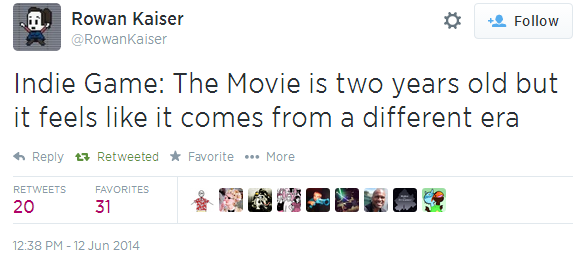
while sitting in a decommissioned airplane in the middle of the Mojave desert in his film A Pervert's Guide to Ideology, Slavoj Zizek paraphrases German philosopher Walter Benjamin by saying that, as humans, we don't understand a culture when we're in the thick of it. only when we're made to see the waste, or the leftovers of a particular culture, do we get an intuition of what culture is about. Indie Game: The Movie is the waste of a culture - and it would be easy just to leave its world and its narratives behind. but i think it's more important than ever to go back and look at it in a slightly different, hopefully wiser light. it may seem presumptuous to be giving a post-mortem to something still so new, yet i believe it's fully appropriate for a culture that has moved and evolved so quickly.

about two years ago, this film - a documentary called Indie Game: The Movie was released - a movie that purported to humanize game-making by profiling a few creators' struggles making their games. two years later, its lasting impact can be best summarized by this tweet:


IG:TM was originally supposed to follow the indie scene at large as it was developing, between 2008-2010 - the culture of game jams and the IGF - but it ended up settling on a few stories for the sake of stronger storytelling. it kept the moniker Indie Game: The Movie in the transition from profiling the scene as a whole to a few subjects, despite following three of the most obviously high-profile games at the time. in my review from 2012 i made the point that by calling their film "Indie Game: The Movie" and then only following the most high-profile stories, the filmmakers were erasing the biggest swath of the truly interesting, risky stuff getting made in the independent game world. i'm not going to chalk this up to ignorance on their part - it was 100% a conscious choice of the filmmakers to follow the games with the highest commercial stakes, and it does a lot to give watching the movie a feeling like it's peddling "indie" success narratives.

as a story, and as a little capsule of cultural tourism, IG:TM provided a human enough portrait to get viewers who might otherwise think of game makers as Mountain Dew-swilling, Call of Duty playing manchildren to perhaps reconsider that image and see games as something that 'real people' make. most reviews at the time focused on this point, which is maybe is a testament to just how regressive image the games and nerd culture has in the larger cultural consciousness. for those involved in making games, it probably felt good to have their passions be legitimized by a very professional-looking production. more than a surface look at the film, however, leaves us with a bland, toothless, glorified advertisement that panders to both its audience and its subjects.

i would say Indie Game: The Movie was the final nail in the coffin that destroyed "indie". but on the ground level, the community has only continued to grow enormously since the time it came out. the only difference is that the stakes are higher now and there are more developers, more of whom are quickly finding that they're part of a much different world than the one described in Indie Game: The Movie. if "indie" has died, in its wake is the slow birth of videogames' conscience. and it's more apparent than ever that there are many people who are not recognized - because they're women, or people of color, or queer, or non-American, or don't know how to exploit marketing language and the culture of the IGF in the way successful indies have, or because the market is oversaturated. the indie game boom was no less reflection of the tech/start-up world's cocky white dude-exclusivity five years ago as it is now, it's just that there are more conflicting voices now to cast more shadows over the previous narratives. Indie Game: The Movie was always about "white dudes remaking Mario" (to quote Anna Anthropy), and it was always parroting a false narrative of success, the only difference is its become all the more obvious now by what's come after.

maybe that also explains why all of its subjects have since seemed to develop a more troubled and cantankerous relationship with the limelight and participation in the indie game world as a whole. Indie Game: The Movie created false expectations for success in many young viewers' minds, and ended up leaving its unwitting subjects looking ungrateful for not greeting that newfound fame and success with open arms. you will never see Jon Blow or Edmund McMillen or Phil Fish openly talking to fans or acquaintances at videogame conferences (if you see them all) like you might have seen at some point before. they're aware of all the resentment placed on them for the ones being profiled, and their walls are up much higher. they seem deeply uncomfortable with the social effect participating in the movie has had on their lives and how they're perceived in the indie world. this is becoming a common trend with newly successful young male game makers who don't have the mental or emotional capacity to handle all the sudden money and fame from having a commercially successful game.


these lingering sour feelings after IG:TM's success recently popped up again in a video on youtube which purports to undergo a deep cultural analysis of "indie celebrity" titled "This Is Phil Fish". among the points made in the video is that Phil's behavior didn't change from being a poster on the tigsource forums when Fez began development to when it became popular, but his level of exposure did. because of his cockiness, and the seeming disproportionate level of focus on his project with a catchy technical gimmick and flashy pixel art, "we" made our image of him into an annoying entitled brat through our own preconceptions, and the expectations for celebrities and their behavior. if Phil had stayed a bro who stayed inside the lines of acceptable behavior, he'd probably be worshiped as an indie hero (maybe more like Edmund McMillen). instead, people see him as a spoiled, pretentious jerk and left him death threats when he decided to cancel Fez 2. the video attempts to provide a complex portrait of internet "indie" celebrity through his situation, but inevitably paints Phil as a hapless, naive victim who was unwittingly thrust into this role of celebrity without his consent. it says that we put him there because he seemed to perfectly embody the type of ugly entitlement we don't like to see made visible.

this analysis is interesting, and i can't lie and say that under the hatred of Fish isn't some of the rabid xenophobia and anti-intellectualism that sits deep in the heart of fan culture. but the video also makes some serious presumptions. first of all, we don't know how much of willing participant Fish was or wasn't in courting this role of "indie celebrity". celebrity is often thrust on people, but that doesn't also mean that they don't also court it. the only person who knows what was going on in Phil's head is Phil, and i'm not really interested in speculating either way, particularly because it seems to be participating in the same kind of martyring process the video is attempting to critique. besides, i've heard enough that isn't public knowledge to not think very fondly of Fish's behavior for multiple reasons. but even that isn't important beyond the individuals involved, which is why i'm not even particularly interested in using him as the subject for this detailed analysis. there are several other people who are way more unjustly demonized, namely Anita fucking Sarkeesian, for one.

game developers come from nerd culture, often growing up seeing themselves as losers and outsiders. because they're afraid of being undesirable grotesque manchildren media has made them fear they are, they continue to believe themselves to be the victims. this fear blinds them into adulthood from seeing their newfound privilege and when and how they're participating as a part of the established dominant culture. in 2013, Hotline Miami developer Cactus told me to give him a blowjob when i (quite sincerely) asked him if he wanted a hug because he was upset he didn't win at IGF 2013. he said he thought he was going to win the Grand Prize "just like Fez", which won the year before. he later apologized to me in an email after i tweeted what he said publicly, and said he was upset at me for the tone in a review i wrote of his game (despite that we had had a very civil email exchange about the review before i met him at the IGF) and that he was very drunk and having a bad week. i more or less dropped it after he apologized, but still keep coming back to the level of entitlement in his behavior. i believe he felt he was owed the award because of HLM's commercial success, and because of his ubiquity for several years in the indie scene. HLM was a resounding success, yet he acted like i had overstepped some serious boundary for writing one negative review. and i just still can't wrap my fucking head around that.

just the same, this situation leads me to believe Phil also thought he was entitled to the 2012 IGF grand prize, because he believed in the narrative that was being painted for him. and when there was backlash when he won, he very much tried everything he could paint himself as a victim in the midst of this instead of trying to reach some awareness about what was happening or why other people were upset. an analysis is only so true as the agenda you enter into it with. he might have been an unwitting participant in his own demonization, but that doesn't mean he didn't come into it with a great deal of entitlement. yes, there is a certain kind of pomposity and grandiosity to his manner which often gets read as "pretentious" and pushes the xenophobic anti-intellectual gamer contingent's buttons super hard down to 'attack dog' mode. when this happens, it can seem weird and arbitrary and not fair. but they are also responding to a kind of entitlement that is, at the end of the day, very real.


maybe people view "indie" as entitled because it is entitled?

"This Is Phil Fish", in its inert, smug navel-gazing, merely reflects back the entitlement of the indie world. in the end it offers no particularly controversial or new insights about celebrity culture, but creates a sense of being a relevant and no-holds-barred commentary to those who are intimately aware of the subject matter. it attempts to exonerate Phil Fish to a lot of the young white dudes who are involved in the indie game community and probably want to identify with Fish. they see his case as "fascinating" and are much more ready and willing to accept that they might have made a snap judgment when they can see their subject as just a misunderstood one of their own. maybe they even want to fantasize about themselves as a rich and famous white dude game dev that people talk about, even if an infamous one. just the same, they are much more willing to relate themselves to a person like Cactus when he makes a poor lapse in judgment, because he is one them. but this sudden well of empathy seems to dry up once it's applied to an outsider like Sarkeesian.

in a sphere of entitlement, people involved are not able to see how their actions reflect their privilege or adds to the oppression of the dominant culture around them, and only take criticisms to their behaviors as bitterness or personal attacks. the indie community is a serious cross-section of haves and have nots, and what discussions are and aren't happening in the open often reflects this. 

in general, the way a discussion is framed - and especially what doesn't get talked about openly in the major public sphere reflects the values our culture. outcry about the lack of women at the recent E3 from sites like Polygon appear to be a clear sign of progress in a historically extremely retrogressive industry, but leave behind a lot in their discussion. while more diversity is obviously a good thing, it's a very small victory when the industry as a whole relies on rapid turnover to keep itself going, and generally is known for bad ethical decisions, both in how employees are often treated and in the lowest common denominator content of games they make. if the industry can't even bother to treat any of its workers well, why would more women and queer people and people of color want to enter it? when most AAA games reflect hyper-imperialist values, why would more marginalized people want representation in them?


in indie games, even what's seen as an "experimental" game also reflects a huge gap between what's actually happening and what's being openly recognized by the culture at large. Aevee Bee and Lana Polansky made the point on a IndiE3 panel about experimental games this past weekend that a lot of smaller-scale experimental game developers either don't have the resources, don't have the ability, or don't have the desire to exploit the kind of marketing tools necessary to sell their games to a wider audience of gamers. a lot of them, therefore, get thrown under the bus and erased by narratives of what's happening in a larger indie culture that's looking more for the more glamorized Indie Game: The Movie-style games. this has absolutely nothing to do with whether what smaller-scale devs make is somehow more or less interesting idea-wise at all, just that it's less marketable.

and in a time where there are more women and people of color making games than ever, the Experimental Gameplay Workshop at GDC this past March had a total of 1 woman (Auriea Harvey from Tale of Tales) and a vast majority of white people (a notable exception being Mahdi Bahrami, an Iranian developer who was a hold-over from a previous year's submission because of visa issues and, again, Auriea Harvey). this is out of a speaker list of over 20 people. a vast majority of the games either relied on some sort of simple technological "hook" or more larger-scale complicated technical systems. somehow, Harmonix and Double Fine were part of the panel. the smaller scale experimental "narrative" games like Passage or Gravitation mentioned as a signpost on the EGW submission form seem to have been slowly phased out and replaced by a place to start the hype machine on the next sexy, marketable gimmick. this cult of marketability defines the EGW now, and makes it seem a lot more like the breeding ground for The Next Braid than any relevant cross-section of experimental games.

i guess you could say the business focus is no big surprise, as the EGW is held at one of world's biggest videogame business conferences. but then why choose to get upset at AAA's lack of representation and not upset at the lack of representation in experimental games? shouldn't recognition of marginalized ideas and concepts be what experimental gameplay is about? isn't it even vastly more important that marginalized devs who have way less opportunities for exposure be recognized? shouldn't we be holding Robin Hunicke, the organizer, accountable for this stuff, and not give her a pass just because she's a woman?


the point is, there are implicit agendas in place behind what things are and aren't openly criticized. those agendas often aren't consciously being enacted, but their being unconscious makes their effects no less real or serious. and a lot of what gets unsaid reflects a culture defined by privilege-blindness. making these criticisms openly is the sign of a community with a healthy panoply of voices. and yet i see a troubling lack of people on the inside who are any willing to undertake any kind of criticism of them. people continually call for diversity and then continually stop listening when diverse voices start speaking. either you speak out and get ignored or become silent and be part of the establishment. when i've heard from so many people participating in the indie game world who have misgivings and come to me and tell me how much they are deathly afraid to talk openly about their misgivings without seriously hurting a friend's feelings and losing a friendship or that saying the wrong thing that will ruin their career, then that's a pretty clear sign there is a stagnant culture. fear of losing friendships and social support is without a doubt the strongest and most effective motivator for maintaining the status quo. all of this make the "indie" world a place rife with paranoia and insecurity, one often masked by an awkward gushing surface congeniality.

the bottom of indie culture seems like it's bound to drop out any time soon, it's just a matter of when and how hard. and when it does, who will be there to build something more durable?

Friday, April 4, 2014

Into (and Out Of) The Belly of the Beast

you know, i'm a strong woman. i'm realizing this more and more every day. i don't care what anyone else might have to say to me about it.

i'm a woman. whatever objective definition may or may not exist of that word doesn't matter at this point, because that's how i'm seen now. that's the role i embody. and i actually feel a lot more comfortable with it, as arbitrary as it might seem at times. and now i'm standing in the middle of a swanky apartment in SF holding a rum and coke in a room full of women (and some non-binary people) who work in the game industry or connected fields, wondering what the hell this is all about. i only got into this party because i was in the right place at the right time the night before - and the guy at the front didn't even see my name on the list, but he let me in anyway, saying "i'm just out here as a formality, honey" warmly and laughing. up until a couple years or so ago, i'd never felt like i'd been at the right place at the right time for anything.

i spend so much time and energy just trying to stay human, and yet i usually feel like the token alien lifeform in any given group of people. the whole week of GDC 2014 i'm occupied with thoughts of my impending homelessness at the end of the week. it seemed like a bit of a cruel joke, with more potential offers for money and work coming my way than ever before. everything was falling apart, but something new was also coming together. i feel so hopelessly inept at living my life in so many ways, yet so extremely confident in others. and now, suddenly i'm a part of a community. suddenly everyone seems really nice to me and tells me they respect my work. suddenly i feel much less guarded towards them, and, for the first time, believe they're being sincere. and yet i still don't know where i'm going to sleep at the end of the week.

i'm spending the week incessantly handing out my obnoxious business cards to everyone i meet, advertising my obnoxious game - the game no one's supposed to like. a game about upsetting shit a lot of people never want to think about. i was secretly hoping that i'd push some of them away or offend them. and nearly everyone is saying "wow, this is so cool!" i doubt they'd feel that way if they spent serious time actually playing the game, of course. just yesterday Cara Ellison told me "your games make me feel really bad" in (presumably) the most flattering way she could muster. it's a hard thing to hear from anyone, but it's what i've gotten used to hearing.

being a woman - defining and reevaluating myself as a woman, leaves me in uncertain territory. there are less examples for me to look to. buildings previously built up by all the things i've looked to in the past crumble, and now i see how flimsy they were in the first place. i struggle to feel i'm really occupying the same space as these women, but i'm definitely feeling a positive vibe i didn't expect to feel from them. maybe it's that women in games are so intensely targeted and marginalized, they couldn't help but emotionally support each other and try and birth something new and interesting. not that those women aren't often equally lethal towards each other - a reality i'd became increasingly acquainted with all too well in the past year. or maybe this is just how things really work in creative communities - that just because i'd never really heard many stories of women in male-dominated worlds didn't mean they hadn't existed all over the place.

presumably i'm some sort of Game Designer or Game Thinker or whatever, but i don't pretend like there isn't a lot i don't know about games. so i go to heavily praised talks like The Experimental Gameplay Workshop at GDC and i see boys with toys. i talk to highly educated, articulate academics who've spent their careers studying videogames and i see boys with toys. i see boys with toys everywhere. i see them skimming along the surface, endlessly posturing. and i just can't get myself to care. but a lot of people seem to love to throw money at them. so i guess i should care. a few of the younger men - ones i've met before who seemed nice enough, if naive, are being hit with walls of paranoia and depression from all the unexpected attention directed at them from their massive commercial successes. they don't seem particularly wise or powerful, they just seem like insecure young people. and there's nothing wrong with that. but because of that, they don't have psychological mechanisms for dealing with the increased scrutiny placed on them as newly successful 'indie game' celebrities. they seem guarded, and not in good emotional places despite their new-found wealth. meanwhile others who i might respect, who are used to relative marginalization or obscurity next to these celebrities shrug their shoulders and continue doing what they do. no amount of demographic breakdowns and marketing analysis can mask the fact that it's all so deeply arbitrary, and more people seem to be realizing it.

i don't have any respect for the videogame industry as an entity. i have no respect for its labor practices, nor its artistic aims, nor the imagery it worships, nor its treatment of women or other minorities, nor the parasitic relationship it has with its consumers. i think it's disgusting and abhorrent. so i can't say that i respect GDC, as a business conference that stands to represent the values of the videogame industry. nor do i support the IGF, in its endless hype and favoritism, nor in its aim to award 'indie' games with (for the most part) already the highest levels of cultural exposure. but individuals often start to change, even when the worlds they occupy remain as stubborn and stagnant as ever. i appreciate when Brandon Boyer says onstage in the IGF awards that he supports people involved in games fragmenting off and pushing in whatever directions they want to push in, even if he doesn't understand it. i appreciate it when i can have an honest conversation with a deeply professional woman who's spent much of her life in the game industry, even if she might not ever really understand what i'm trying to do with a thing like Problem Attic.

a small one-day conference called Critical Proximity, the day before GDC, mostly made up of young people, seems to be much more interesting and relevant than nearly anything at GDC - despite the appearance of a "videogame criticism" conference sounding like a comically narrow focus from the outside. there was a lot of talk about how to maintain supportive communities, yet in the final talk Ian Bogost (or "Old Man Bogost" as i've come to call him) still seemed intent on breaking up any kind of delusions of community love that might have been held over the course of the conference, or anything that distracts videogame critics from doing the thing videogame critics are presumably supposed to be doing. and fair enough - maybe there is no community. maybe we don't want community. others, like Samantha Allen, made this point too. maybe things will continue to shift and fall apart unpredictably. but even if there is no community, there is a lot of genuine sincerity, and genuine desire to support other people - and that's a thing that doesn't just materialize out of thin air.

then - walking into Moscone Center for the third year in a row, i knew enough to know what i was going to get this time around. i knew the way places like the Bay Area or LA or NYC like to mythologize themselves. i knew that the interesting stuff is most often happening outside of these events, and outside those cities. that is, unless maybe you're David Kanaga or Pippin Barr and you're doing genuinely exciting, genuinely cutting-edge experiments at the intersection of performance art and games. and then, a lot of people are probably either very confused by or very indifferent to you. or if your name is Tale of Tales, and your sustained visibility over the years hasn't done much of anything to move you out of a strange, liminal, heavily marginalized space between the overly stagnant, overly stuffy art world and the overly commercial, overly nasty game world.

i don't know what will happen with videogames in the next ten years. i don't know to be excited about what will happen in them or not. i almost don't care. so much ground is gained, so much ground is lost. so many things have been changing surprisingly quickly, so many stay the same and show no signs of ever being different. i still don't understand why people who make videogames need to separate themselves out from other creative communities creating other forms of digital media, and justify why videogames are more exceptional than them. nor do i understand why those other worlds continually seem to fail to seriously engage with videogames. either way, a lot of people who make videogames are certainly here, and certainly don't seem to be going anywhere any time soon. and neither am i - nor am i homeless anymore, by the way. thank you, patreon!

i'm a woman and a human being who wants to make art. i never saw this as being particularly controversial. nor do i see my need to not limit myself to one medium as being particularly unusual, in an age of easy access to a plethora of different digital tools. and so i'm always shocked to see how much confusion seems to come from that. either i'm overextending myself, or i'm ruining my chance at a establishing a real career by going too far up my own ass. but here i am, still strong as ever. now able to pay rent. and i'm not changing, nor am i going anywhere. and whether or not my need to feel human makes me an alien to others, i'm happy to receive all the support and love i have from this community - strange as it may be, nonexistent as it may or may not be.

and so i say this sincerely, from the bottom of my heart: we might not always understand each other or be on the same page (or even in the same book!) as each other. i might find game culture endlessly infuriating and puzzling. but i know your support is genuine. and i'm really, really flattered. thank you so much, everyone. =)

Sunday, December 29, 2013

2013: my year

in 2013 i did 3 things i'm particularly proud of:

1. Problem Attic. i'd never done a real, honest-to-god project i felt proud of. finishing this lifted that weight off me. it also confirmed a lot of things i already knew. there were a lot of things that hurt me in the past year, and a lot of drama that caused ripples and split a lot of people i've been around apart. the time when i finished the initial version of PA felt like the epicenter of all of it. it's been really hard for me to deal with that feeling, like you have something you're trying so desperately to say but you're being ignored and swept under the rug by everyone around you because you're not as loud as them.

all this led me to feeling suicidal for maybe the first real time in my life. i guess the price you pay for doing things your way is feeling increasingly alienated from people around you. i spent several months being upset that many people i knew didn't even seem to want to go near my game, let alone entertain the idea that there might be something more there. the IndieCade rejection form was another blow, especially when a couple judges assumed i made the artistic choices i did in the game because i was inept. i'm also preparing for the inevitable disinterest from the IGF. i'll probably submit it to the Experimental Gameplay Workshop at GDC next year, if only because it's free, but i'm not hoping for much. and then i'll probably call the whole "attempting to get exposure for it" quits.

i've felt increasingly like everyone i know thinks i'm crazy and self-absorbed for harping on this game so much and just wants me to give it a rest. but i'm a stubborn person, and that deep stubbornness is what made that game, and is what motivates in general me to keep going and doing what i do. so that's what's i'm going to do.

i'm very proud to have made this game, and i think it's probably one of those things that will gain in reputation over time. i felt really overjoyed to see that there are some people (people i don't know at all, too!) who feel the same way. it makes me feel like i'm not so crazy for believing this after all. my dream is still to make it as an electronic musician, but maybe i'll keep trying to give this games thing more chances.

2. the three extended tracks i did on the MirrorMoon EP OST. i've struggled a lot with music for many years, and these have felt like by far the most cohesive things i've done in recent years. though if you want to give me money, you should do so on my bandcamp.

3. the two talks i gave: Re: Fuck Videogames and The Abstract And The Feminine. the former is a response to a bunch of different things going on in games around 2013, and i think more people need to read it if they can deal with eye-fucking and a few typos i'm too lazy to fix. the latter talks about a lot of issues surrounding gender (gender and art in particular) that a lot of people seem to ignore, so i think it's important to check out.

i'm not really a natural-born speaker and i still have a lot of dysphoria about my voice, so speaking at both conferences was a real challenge. at No Show in Boston, where i gave Re: Fuck Videogames, Courtney Stanton (the organizer) was nice enough to cover my flight and her and her husband Darius Kazemi were gracious hosts for someone like me who otherwise never would've been able to afford flying out to the east coast. unfortunately for the talk itself, i wrote everything in my talk out in article format, which makes for better reading than it did saying out loud. aside from that, i think No Show was an excellent and well run conference and i may attempt to submit a talk there next year .

my QGCon talk went a lot more smoothly, and i think i was able to convey all the thoughts i wanted to in the time allotted. i hope it came off for the people watching it. the conference itself i was happy to see exist, especially really close by, and meet some new faces. there were also several really good talks! but it also felt a little more jumbled and unfocused around several different ideas of what different people thought of as "queer", and some of the talks were basically just boring student dissertations (including a talk about Japanese representation of queer people in games that really bothered me and some other people). also, i hope they fix the audio on the stream next time around so people can actually hear most of the talks!

and of course, GDC and IndieCade were in 2013, both of which i have the benefit of being close to. both were, in themselves, a whirlwind of interesting people and experiences (IndieCade moreso than GDC), even if i feel less than enthusiastic about their overall aims as events, to put it lightly.


other notable things:

- i'm still broke as hell. if anyone likes my work and wants to give me money or help me find gigs doing music for games or whatever else, email or paypal me at liz dot ryerson at gmail or buy my stuff on bandcamp.

- you should play A.L.T., which is the best Doom mod i've ever played. also read my article about it on Unwinnable if you need convincing.

- a few articles i wrote on this blog ended up becoming pretty popular or whatever. i still like this one called "why should i love them?" the most.

- SCRAPS is an album of a lot of old kinda-embarrassing stuff of mine hopefully made less embarrassing by the super cryptic format

- i did the music and sound design for Crypt Worlds and Triad, which was fun.

- i got interviewed in RPS, which was pretty neat.

- i do plan on finishing my Doom videos eventually, but they're not a priority.

- speaking of that, apparently people kinda like it when you pretend to talk about whatever big current AAA game, even if what you're saying is not related at all.

- i wrote a couple more Wolfenstein 3d level design articles early this year, for anyone who might have missed them.

- i made Responsibilities w/Andi McClure at the very end of last year but you should still play it!

- i finally updated my website (ellaguro.com), which is still very much a WIP. i'm fond of the icons.

- i'm posting assorted other bits (like the glitch art stuff i've been doing the past couple days) on my tumblr, ellaguro.tumblr.com