Thursday, May 2, 2013

Bioshock Infinite: A Completely Sincere, Not At All Manipulative or Self-Aggrandizing Journey Inward

i've posted this on twitter and elsewhere, but here is my deeply insightful commentary of parts of CliffyB's wonderful sleeper hit of this year, Bioshock Infinite:


it was originally done for an event organized by Jake Elliott, designer of Kentucky Route Zero (among other games). the video was fairly inspired by Jim Munroe's semi-famous GTA3 machinima "My Trip To Liberty City", which was the impetus for the whole event.

enjoy!

Wednesday, May 1, 2013

it's okay to like games

this post is somewhat inspired by me being very confused and frankly kind of disturbed after reading about this man's experiences quitting the internet for a year. he seems in many ways like the perfect portrait of a clueless, aimless white middle-class 20-something. with that in mind:


it's okay to like videogames. yes, the culture is bad. the culture is very bad. i'm not making any excuses for it.

there's an undertone of shame to a great percentage of writing i read about games. the tone is of "i'm a pathetic human being who can't live a normal and healthy life and that's why i play videogames". from there one either attempts to exorcise that shame in a cathartic burst of words to connect with an audience of similarly-minded shame-feelers or defends it in all kinds of silly and childish ways and grasps at straws and greatly inflates particular experiences with games in an attempt to prove to the greater culture supposedly oppressive towards games that the experiences are legitimate and meaningful. either way says much more about the writer than it does about the game itself. games, like any other medium have absolutely no need to prove they are legitimate in the first place. they exist, therefore they are legitimate.

videogames are addicting, sure, but all entertainment is addicting. it's plenty easy to get lost into the worlds of tv shows or films too. addiction is a personal compulsion. it's not an excuse to say that a videogame is causing addicting behavior, though many commercial games certainly have tried to feed off that as best they can.

your feelings are valid. you are not a victim. entertainment is making you feel like you're missing out, like you're a loser for not participating in this imaginary cultural image of what people in their 20's in 30's are supposed to be doing. this is not real. culture is preying on you. stop being a victim, and stop feeling sorry for yourself.

if you feel passionate about games, it's almost certainly because you've had enjoyable and meaningful experiences with them in the past. sure, maybe they were an escape from a stressful or lonely or depressive or abusive external life, but there's more to it than that. there's a joy there from experiencing and exploring a digital space, just as anyone would feel joy from exploring a non-digital space. don't try to devalue that. it is perfectly genuine, as are any other of your experiences outside the digital realm. it's just one other way to interact with the world.

do you have friends? you should call up a friend and hang out. just spending time around other people in the same room as you is nice. even if you're playing videogames - at least talk to each other. don't spend your time staring at your phone or computer. you don't have to escape into the woods and meditate for 12 hours every day in order to live life and feel okay about yourself. games are not a substitute for human interaction, nor should they be. games are not destroying human interaction either. they are what they are and they do what they do, no more or no less than that.

movies and and books and music and visual art are not inherently more or less valid than games. they're just another aspect of the human experience. they do, however, have a lot more breadth because of existing as a medium for much longer. being aware of them is a good way to open up to a lot of things you will certainly miss playing videogames. but you shouldn't feel shamed into consuming them, or that you are a lesser person for not being aware of one thing or another. nor are they there as a "pretentious" exercises in manipulation or making you feel bad. art is there to enrich and be enjoyed, not score social points. fuck anyone who treats it the latter way. the impulse to make art is a basic human one, not an attempt to make oneself feel superior to others.

i'm tired of feeling like i'm writing to 17 year olds when i write about games. if we can't accept a base level of validity to the thing we're talking about without having to constantly feel shame and prove and defend its existence, then i'm not interested in participating in discussions surrounding games. it's stupid and boring to have so much of the talk be constantly channeled through that. who cares what Roger Ebert or whoever else who never played a videogame thinks or has thought. games are games and they can do good or bad things depending on how they're used. they're only just one tool.

so yes, turn off your computer once in awhile and watch a good movie or read a book. or go walk around in the park and cook your own food or all of that. those are important parts of the human experience. but don't do it as an exercise in shame. and don't do it thinking it will make you a perfect person, and therefore cure you of the dirty vice of games. and definitely don't expect it to provide you with same kind of experience as a game does. a videogame is not meant to give you a life. when it does, it's usually a pretty poor one. it is just one tiny window in a vast ocean of human experience. it's a pretty neat window sometimes, but that's all it is. to acknowledge this also opens up the possibility of being a somewhat happy, empathetic, socially aware person who can still enjoy games for what they are - and no more or no less than that.

Thursday, April 4, 2013

Saturday, February 23, 2013

adventures in level design: Wolfenstein 3D Episode 3: "Die, Fuhrer, Die" PART TWO


the Fuhrer welcomes you to the conclusion of Ridiculous Videogame Representations of Historical Events.

in part one i focused mostly on how Romero established a pretty consistent design vocabulary in the first five maps, only to be called into question by Tom Hall's map six. when talking about any of these sorts of things, it's very difficult to tell how intentional the pacing is, and how much of it is just an odd, random juxtaposition that happened by chance. there is really no way to tell how far the experience lies on each side of the spectrum. i can, however, give my own interpretation based on my own experiences playing them. and we've seen how creators can create experiences that end up being about something much deeper, or at least much stranger than what they could consciously articulate about they were doing. 

this is both the joy and the frustration about a game like Wolfenstein 3D. it gives the player enough in the design to call into question what they're seeing, but never really escapes outside the confines of being A Videogame Released in 1992. one could just say that things were made this way because that's how Hall or Romero felt like they should be made, or because they thought it was fun, or funny. but that's an easy way to absolve oneself of artistic responsibility that game designers have traditionally used throughout the history of games, and doesn't really answer any of the deeper questions about the experience players face.

Friday, February 22, 2013

adventures in level design: Wolfenstein 3D Episode 3: "Die, Fuhrer, Die" PART ONE


episode 3 of Wolfenstein 3D, otherwise known as "Die, Fuhrer, Die" or The One Where You Kill Hitler, is probably the most-played episode of the registered version of Wolf3D, no doubt because of the fact that You Get To Kill Hitler. if a new generation of WW2 based FPS games have proven anything, it's that people in the have an endless fixation with killing Nazis. undoubtedly these people would have played this episode. and they'd get what exactly what they wanted, in some ways, but not before getting something a bit stranger and more disturbing.

"Die, Fuhrer, Die" is an interesting example of how pacing and context greatly affect how players will respond. everyone playing it had a vested interest in reaching the end and to see Hitler as the end boss in a videogame. its nine (not counting the secret level) maps do follow a pretty typical linear get-more-crazy-as-you-go-on progression, and much of the levels feel pretty internally consistent to each other. but it also undergoes an abrupt shift a little bit more than halfway through the episode, from by far the easiest set of maps in the the game with cohesive, short levels to a little bit weird and amorphous. this is partly because it's the most true collaboration of the two map designers for the game: John Romero and Tom Hall. floors one through five were designed by Romero, and are among the shortest and easiest maps in the game, though not without a few tricks. floors six through eight were designed by Hall (who did a majority of Wolf3D's maps), and take the episode into a bit of an alternate-universe netherworld version of the first five maps, if they can even be compared to those maps at all, before sending you plummeting towards the final showdown with Hitler (which is designed, again, by Romero). 

i'm gonna start by talking about three of the first five maps (two, three, and five) and then the turning point, when things start to get stranger and more complicated, at map six. i'm skipping floors one and four because they're two of the most conventional-feeling and, quite frankly, boring maps in the game for me. part two of this article, coming soon, will focus on maps seven through nine. 

please note that from now on, i'm going to use the terms "map" or "floor" instead of "level" to describe each map, because "floor" is how the game refers to each of the level on the player's status bar, and "map" refers to what it is, design-wise. 

also note you can put the mouse cursor over the ingame shots (and also click on them) to see them without my lovingly mouse-drawn labels.

without further ado, here's floor two:

Wednesday, February 13, 2013

why should i love them?


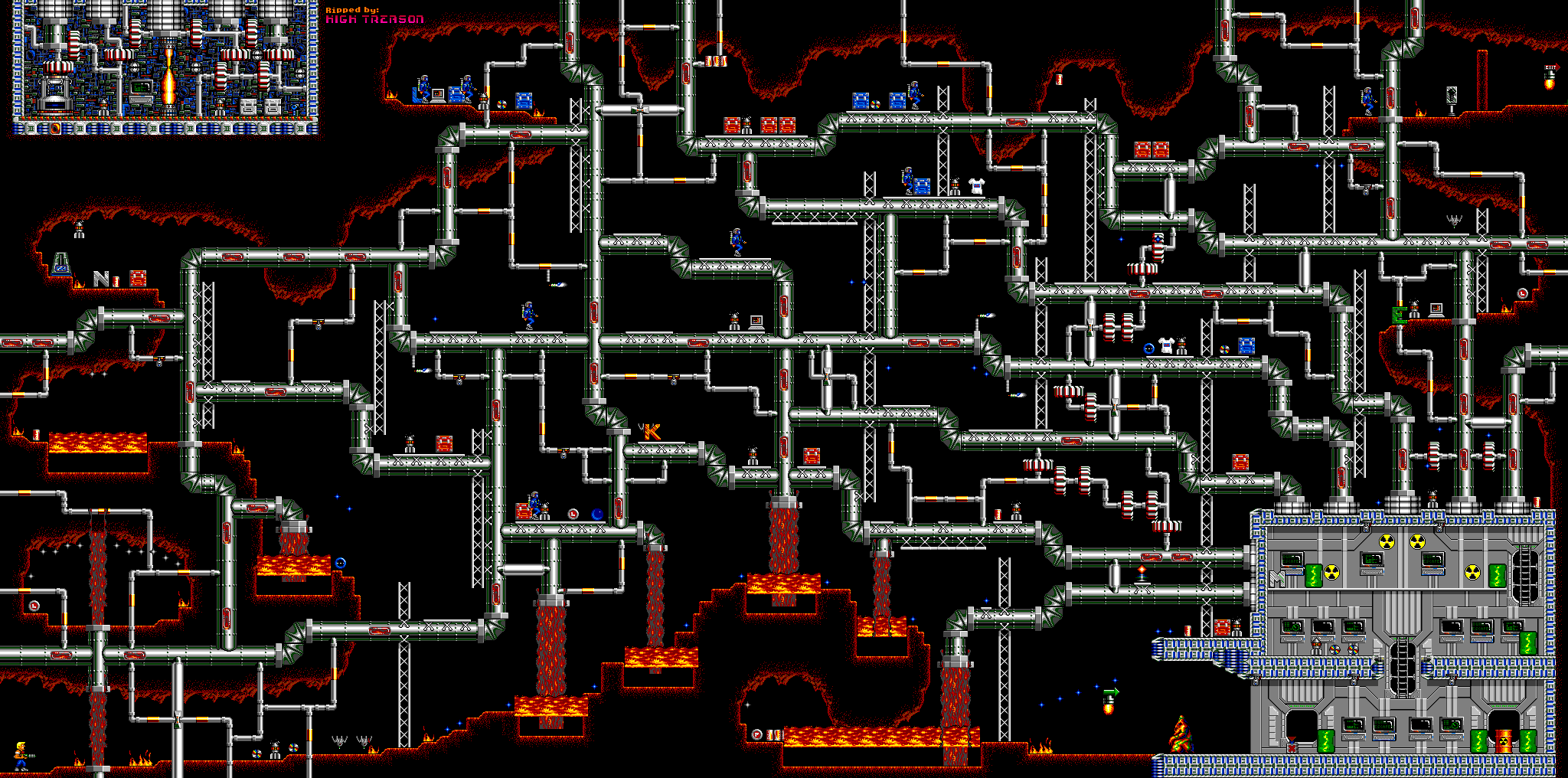
this is level six from the shareware episode of a videogame released in 1993 by Apogee Software for the Disk Operating System (aka DOS). the most notable thing about this game, beyond that it's a lesser-known predecessor to the game that turned the pop-trash-culture-quipping icon of hyper-misogyny Duke Nukem into a household name, is that it's in many ways a pretty egregious rip-off of the Turrican series, particularly Turrican 2, and borrows many game ideas (and graphics) from it. i could go into great detail on the extent of the things that are ripped off from that series, some rather pointlessly or randomly, but that isn't really the point. the point, for me, is that i played Duke Nukem 2 when i was young and impressionable, and hadn't even heard of Turrican 2 until maybe last year.

because of the highly-embraced ugly values of what the Duke Nukem of Duke 3D and beyond represents in the "gaming pantheon", it would be easy for anyone who identifies as any kind of self-respecting feminist to mercilessly trash these games. not to mention that i have a friend in the industry who sees Apogee/3D Realms's business guy Scott Miller as an piece of utter human garbage because of the way he conducted his company over the years. but as is the case with many commercial games over the medium's history, the DN games tell contradicting stories.

these kind of games always led a very transient existence. the crushing wave of constant technological advancement that forced developers to constantly make their games bigger, longer, faster, better-looking or be left in the dust ensured this. in a year or two (maybe less), they'd become completely irrelevant, and players would seek out something else. the point was to just make whatever you thought might make money within the narrow gap of time you had that hopefully aligned with your own interests as a designer. most of the design decisions made in that era end up being attributed to the consumer demand (or at least perceived consumer demand) or not having enough time to think of anything better, or just plain ignorance. designers still didn't really know what they were doing at all, but had at least a decade of experiments and mistakes behind them to build off of. the more perceptive and imaginative designers seemed to have some kind of intuitive sense that there was a vocabulary of design decisions that were maybe "cool" and ones that were "uncool", and how to be interesting and engaging while still making something that could sell, even if they didn't know how to articulate this consciously. or maybe, in the end, it was mostly just luck and being in the right place at the right time while being too dumb to know any better.

games and anything game-like were, meanwhile, very deeply marginalized by larger culture. the media acted as if games couldn't be anything but these quirky, abstract little kid's toys. by the end of the 90's, developers were starting to undertake greater efforts to make games more "real" so they could be some kind of participant in mainstream (usually film) culture. this is where you began to see a split between games packaging themselves on the surface as purporting to be some part of larger, more "legitimate" cultural tradition, and the still very "videogamey" design decisions made by many designers. over the years, a couple of different narratives have floated around, both of which marginalize the "videogamey" side. people in the industry now tend to see that kind of abstraction as a relic of technological limitations or designer ignorance that games had to accept because they didn't have the processing power to make more realistic human environments. the educated, culturally-aware people who wish for games to become something "greater" now have mostly learned to accept that games must completely wear on their surface their hope to be a part of larger culture. anything that might seemingly run counter to that must be falsely empowering, "videogamey" nonsense.

what popular culture remembers about Duke Nukem 3D is that in the first level you could go into a movie theater and watch an animation of a scantily clad woman and you could blow a hole in the woman to find a secret, and in a later level there was a strip club and you could play pool and pay the strippers to strip or kill them. anyone playing the game now might be very confused to find that the experience of actually playing the game is much weirder and more unsettling than they probably ever remembered. one might forget that there was a second episode (my favorite) entirely set in space with all kinds of evocative, abstract, and terrifying environments. Ken Silverman's Build engine led to an explosion of creativity for the level designers, who were presumably looking to take complexity of environments one step further from previous FPS games like Doom. but the winners write the history on their own terms. the Bruce Campbell wannabe character Duke Nukem quickly wrote over anything in the game of his namesake that might contradict what he stood for.

in the case of level six of Duke Nukem 2, pictured above, there is so much fucking weird shit cluttering up the environment. you wander around climbing ladders and jumping from pipe to pipe, killing guards and disabling robot drones and shooting open differently colored boxes that will give you more health or weapon power or points and searching for where to go. as it turns out, you don't need any items to reach the teleporter that leads you to the key you need, in the area on the bottom right of the map where the pipes connect up to (though powerups help). there is a stronger, mini-boss style flame enemy, a save point, and bunch of guards on computer terminals who are guarding a teleport to go inside the machinery to the area on the top left of the screen, where the key is. once you have the key, you can use it to open the exit on the top right of the level.

this all seems easy enough, but because the size of your screen is so small, the act of navigation is very confusing (you can see this in this video playthrough of the level). it's really hard to tell where you need to be at any given time. it seems as if the pipes could just go on in every direction, forever, and there are so many fucking boxes hiding items around, some helpful, some that hurt you to add to the confusion. and yet, there's a beauty to the level that can only be witnessed when it's completely zoomed out like in the image above. piece by piece, through playing the level, you build some kind of relationship with it and begin to construct an image of a coherently functioning environment in your head that might look something like what we can see in the image above, though you'll never actually see that image in the game.

this clever level design, by far one of the most well-realized in the game, seems like it's really undermined by requiring players to be engaged with so much cluttering, seemingly pointless shit from moment-to-moment to get from point A to point B. that stuff was probably all in there because the developers thought it was cool to add more features, not because there's a particularly conscious story the item boxes or turret-bots are trying to tell. young and impressionable me might not have understood why the boxes are there, but accepted them as part of the game and built my own interpretation of the narrative around them. the feeling of playing Duke Nukem 2 was about being overwhelmed and confused by these frustratingly abstract, winding, futuristic hellscapes. it was a game about the world's intense over-saturation of technology turning it into a kind of terrifying wasteland, yet there was something still oddly exciting about it all.

compare this to, let's say, level 8-1 of the first Super Mario Bros game (right click and "open in new tab" to make it bigger).


in a typical 2D Mario game, most levels look like some kind of long horizontal strip. the design is intentionally directing the player towards making a series of linear, moment-to-moment decisions. there's next to no backtracking, or maze navigation, or confusion. in Mario you do have a coins and points and power-ups, and 8-1 is a frustrating trap of a level in many ways: but the game always, no matter what, makes you feel like you know exactly what you need to do and that the end is always within your grasp.

we tend to view that as "good design" and the swirling, incomprehensible mess of a game like Duke Nukem 2 as "bad design". Mario 1 understands what its function is, Duke Nukem 2 doesn't. i won't say that this isn't correct on one level, but it still completely misses the point.

so Duke Nukem games seemed to have no real idea of what that were about, beyond things stolen from other games, until they decided to be about a misogynist bully - and by then it was far too late to erase all of the counter-threads that had been running through those games up to that point. and thank fucking god for that, really. the first game (which i have a special relationship with and hope to write about more), was a clunky, puzzle-filled techno-futurist platformer. the second tried to be less incomprehensible and clunky and move towards a faster action game, but ended up at some awkward point in between the first and some kind of grotesque Turrican rip-off. both are alienating, sometimes weirdly intense experiences to play now.

Duke Nukem 3D was a point of high absurdity for games, built with a bunch of hyper-complex, interactive, abstract environments of keys and switches in the vein of Doom (though often more obviously representational of "real" environments), all masked by the idiotic ugliness of its newly culturally aware protagonist. the marketing story told by the Scott Millers of the industry overwrote the design story told by the Todd Replogles or Allen Blums or Ken Silvermans. afterwards, nothing like it could ever hope to exist. no self-respecting game designer afterwards could ever purport, without extreme embarrassment, to make one kind of game and actually make a completely different one. no self-respecting game designer could ever hope to get away with creating a character as stupid as Duke Nukem ever again, either. the game was an unstable beast that pulled itself apart and pissed on anything that might have hoped to come after.

and so videogames "grew up", but instead of learning to love and embrace their own unique, sometimes seemingly incomprehensible and "videogamey" design vocabulary, they opted instead to convince themselves that they were moving forward, torching the confusing design threads and cognitive dissonances of the past in an endless, stupid search for cultural acceptance. people wanted "real" environments, and "real" stories that they could connect with, so that's what they got. a game like Duke Nukem 2 is now an embarrassment and a relic because it couldn't understand what it was about. a game like Duke 3D is only remembered for its pathetic stabs at cultural legitimacy, and all the idiocy that came after.

i see many game designers of 2013 engaging in a peculiar kind of self-flagellation. they want to erase all the embarrassment of the Duke Nukem 3Ds of the past, instead of trying to come up with any understanding of why games like that existed or what relevant counter-threads the games themselves might offer now. in a post Duke 3D world, they can no longer recall that anything other than the narrative they now accept about videogames ever existed, or if they do they see the past as immature and messy and not at all useful or relevant for the future. they're videogame monks who are trying to retain some idea of purity by completely cleansing themselves of all their previous sins. they're vast oceans away from accepting that the greatest insight tends to be found in the messiest, stupidest, and most broken of places. they stood aside and let the Scott Millers of the world write the story.

if videogames can't love themselves, why should i love them?

Saturday, January 19, 2013

why we talk about ourselves

why do we talk about ourselves when we talk about videogames?

over the past ten years or so, confessional writing in the spirit of "the new games journalism" about deep emotional attachments we have formed around games has taken hold. those who share these experiences have wanted to show how something as seemingly crass and commercial as a videogame could end up inextricably, deeply entwined into fabric of a person's life. in very recent years we've had writing from women, in particular, who have felt awakened to a feeling of being increasingly belittled and marginalized by the games they once loved. Mattie Brice's article "Would You Kindly" is a recent example. Mattie characterizes games of today as a former lover who makes no effort to try to understand the suffering she has to face every day as a transwoman of color. she says the violence in a game like Spec Ops: The Line doesn't look anything like the violence she encounters every day, and that games increasingly just seem the realm of privileged males who are cynically speaking to other privileged males about things that have nothing to do with her own experiences. her being who she is trying to make it in a white male-dominated tech field in a mecca of rich tech-careered males like San Francisco probably has intensified her own feeling of disillusionment, i'm sure.

Greek indie game designer Jonas Kyratzes took objection to this and wrote his response "Would You Kindly Not". he picks up on that Mattie's criticisms of recent games might not be as smoothly made as they could be, and that there are many different kinds of violence that exist throughout the world - not just the ones transwomen or women of color face. i think his larger point of contention is he wants to bring to light his own experiences of violence he's had to face every day, as a former citizen of Greece. and i understand where he's coming from there, to the extent that i can. yes, we all experience our own kind of suffering and violence. yes, transwomen or women of color are not the only people to face violence in the world. yes, it can feel like when one descends into the realm of talking about identity, one speaks as if one's own personal suffering being brought to light is the only thing that is important. yes, not all white men are the perpetrators, or in positions of power. 

but when he tries to make the point that games like Bioshock and Spec Ops: The Line are relevant to people like him who have been through very real experiences of gun violence, he seems to be seeing a phantom. i don't want to question his own emotional investment in those games, but it must be said that most of the people who are making the creative decisions on these big-budget games don't have the kinds of personal experiences, nor have they done the necessary research to really understand the complex issues a game like Spec Ops tries to tackle. Mattie's characterization of those game developers as privileged is more or less correct - because even if they, themselves, are not the ones benefiting from that privilege, they're still buying into the dominant cultural narratives or what games should and shouldn't be - namely, big-budget FPS games. but even if they did approach any real understanding of the complexities of real-life warfare, i'm very skeptical of any triple-A game's ability to make any sort of substantial, coherent criticism of any part of society when shackled by massive team-sizes and market research and having to somehow manage to be enough of a cynically marketed FPS to make a profit within the current market. it just doesn't seem possible. and yet, we have set the bar so low that we're willing to convince ourselves that it is. that, i believe, is pure delusion.

at the heart of Jonas's criticism, though, is a larger issue. why the sudden, endless descent into discussions of identity on game websites? why are there so many game journalists sharing intimate details of their own lives, and what relevance does this kind of writing have to do with the games themselves? there is an immense danger of us failing to look at games critically because of our level of personal, emotional investment in them. we, as Jonas does, regularly see phantoms. we project ourselves onto these games, to where the games become much more about us reaching our own sorts of emotional catharsis than anything to do with the actual content of the game. we tend to explicitly make games with this aim - to be projected onto. and yet, we still try to say that it's the game that took us to these heights, and it's not about us - but it was always about us and everything we brought from ourselves into the game, and not the game itself. 

when i write about games i don't like to let my own experiences dominate the conversation, or let them be fuel for people to feel better about themselves for a fleeting moment. i don't believe i could to any degree adequately convey the emotional complexities of any events of my life, nor do i have really any interest in doing that on a website about videogames. my object is to use my own personal emotional experiences as a tool to highlight things which are already present in games, but are being ignored or not articulated. in the end, when i talk about myself in the context of videogames it's not really about me, but the games themselves.

still, i cannot and will not devalue the emotional experiences other people have with videogames, or try to say it's not genuine or valid to write about them, because that misses the point entirely. it's increasingly impossible to ignore the culture that games have arisen from, and the sort of stranglehold that culture has on all the discourse that occurs. transwomen who want to get into games find themselves on a difficult path (and women in general, but i'm speaking in reference to Mattie's article). most transwomen experience the sort of social isolation and ostracization that many people who get really into videogames experience, except tenfold. videogames represent spaces and experiences separate from our bodies that we can form our own associations with, free from pressures of social identity, while still participating in an activity deemed "socially acceptable" for those categorized as males. games are rife for emotional projection of whatever kind of role you wish to occupy onto them. i can't ignore that they can be excellent tools of self-discovery, and i think this is a big part of why so many transwomen are so passionate about games, and technology in general. yet i also find this to be very dangerous.

i'm not going to make any claims of speaking for all transwomen here. but when, as a transwoman, you find yourself digging through the rubble of the past and trying to discover what kind of person you genuinely want to be, you might find that you still desire very strongly to be a part of these worlds which you've spent most of your life invested in, even when it's not considered socially acceptable anymore. you might also find that these worlds come with an intense oversaturation of anger and ignorance and self-absorption and a lack of basic empathy for other human beings baked into them. transwomen who involve ourselves in videogames have to consciously deal with the transition from one being of the "us" of nerd culture to one of "them", a target of all this misplaced nerd rage, whether we want to or not. this is a very scary feeling, one that male-identified people who have fully built their lives into the socially-accepted role of nerd culture have not experienced. so how do we articulate this fear to an audience of people who have been trained to measure self-worth by the amount of money they make? how do we make them see that the values of success and hard work don't really apply equally to us? how much have these games we've formed such intense emotional attachments to over the course of our lives trained us all into believing that our lives are things that can be gamed?

there is a disturbing amount of rage bubbling underneath the secure pockets of technological introspection that so many of us try to escape into when we want to avoid dealing with each other. i believe it is one that will boil over soon enough. if we don't want to all kill each other, and kill the planet in the process, it's time we who like videogames learned how to start being human - and how to start empathizing with one another.