Showing posts with label DOOM. Show all posts
Tuesday, October 22, 2013
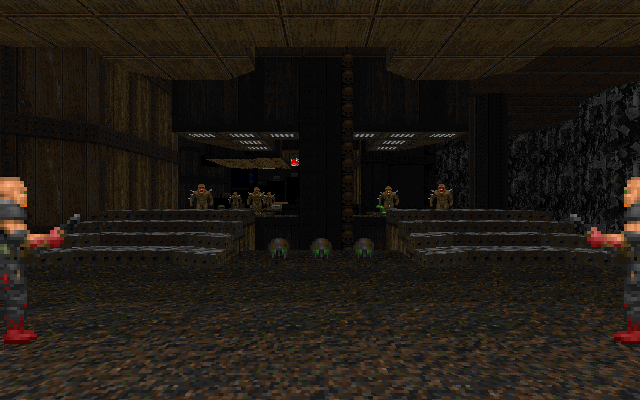
an in-depth look at Doom Episode 1
in the past week i did a few videos looking back at the design of "Knee Deep in the Dead", the original shareware episode of Doom for the game's 20th anniversary (coming up this December). part of my goal was to show why the game, and this episode in particular, has held a strong hold over so many people even 20 years later. i'm not sure whether i really succeeded or not since these videos are fairly off-the-cuff, but hopefully people will get something useful out of them. another part of my goal to show what makes Doom fundamentally different from the current FPS games it's supposed to have spawned. indeed - those games don't really seem have much of anything that comes close to resembling Doom as far as the design of the spaces or the direction of the experience goes. Doom still seems as completely foreign and of another world as it ever has, maybe even moreso.
one thing about the first episode that's clear from both playing back through it and from reading John Romero's design rules (mentioned in the video) beforehand: there's an insistence on a very abstract, but very specific set of rules tailored for the engine the game is made in. the spaces may feel "real" insofaras they are detailed, or their shapes or textures might resemble existing structures in our world - but there's nothing particularly functional about them as architecture outside of the context of the game. and yet you don't feel that at all, as the player. the world makes complete sense once you become acquainted to its language.
and that's what the first episode, in particular, does very well - bringing the player into the language of this very strange, very new kind of experience (when it came out in December 1993) while also providing a surprisingly coherent arc. yet it also subverts the rules it sets out to establish in many subtle but noticeable ways. no design idea is ever exactly repeated in the same way - there's always a new or different twist put on it to stay surprising. if the player starts out in an enclosed, safe area in one map, they'll start out in an open area with enemies in the next. ideas that might seem monotonous on paper come to life in the game because of all the little details and juxtapositions placed in front of you. no part of this episode ever feels like a tutorial or a trudge, because there's no need to tutorialize to get you up to the pace of the story or whatever in the first place. Doom is not trying to be anything other than it is, or tell you it's anything else than what it is. the story is the experience.
that's not to say this is the only valid way to approach to design. it's standard practice in the Doom community to talk shit about Tom Hall or Sandy Petersen's levels for not being as open or elegant or taking advantage of the engine's architecture so self-consciously. a lot of that is they just had less time to work on things, or were part of a compromised, half-realized vision. but that ignores the very strange and interesting ideas that lie in the other two main episodes, even if they don't have the benefit of coming together like in the first. not to mention that sometimes John Romero's maps feel almost silly for their level of interconnected-ness, like he was just trying to make singleplayer levels that doubled as multiplayer levels. but the continual return back to these specific pre-defined design rules create spaces that feel consistent to each other when they might not be otherwise, and i think is a big part of explaining why this first episode still contains the kind of allure it does.
all three videos are here for you to enjoy. look for more videos from me about Doom in the coming month or two, as well as an article about one of my favorite (if not my favorite) Doom mod that's coming soon. enjoy!
Thursday, May 2, 2013
Bioshock Infinite: A Completely Sincere, Not At All Manipulative or Self-Aggrandizing Journey Inward
i've posted this on twitter and elsewhere, but here is my deeply insightful commentary of parts of CliffyB's wonderful sleeper hit of this year, Bioshock Infinite:
it was originally done for an event organized by Jake Elliott, designer of Kentucky Route Zero (among other games). the video was fairly inspired by Jim Munroe's semi-famous GTA3 machinima "My Trip To Liberty City", which was the impetus for the whole event.
enjoy!
it was originally done for an event organized by Jake Elliott, designer of Kentucky Route Zero (among other games). the video was fairly inspired by Jim Munroe's semi-famous GTA3 machinima "My Trip To Liberty City", which was the impetus for the whole event.
enjoy!
Sunday, September 26, 2010
DOOM And What Videogames Are Trying To Tell Us
DOOM
=====
I love DOOM. It’s one of my favorite games. DOOM doesn’t have much of a story. You kill things. There’s something about space marines and the moons of mars. Mostly that’s a way of justifying the setting and why you are killing things.
Most people will say that the killing is the best thing about DOOM. They say that it’s some kind of hyper-masculine empowerment fantasy for bullied kids or for adults who want to turn a shotgun on their bosses and families. That’s the way it got played out at the time, anyway. DOOM scared a lot of people. It was intense. It was frighteningly visceral. You could kill other people, virtually. The game can give a weirdly empowered feeling, like maybe someone who’s in the midst of some sort of manic episode. So DOOM and other violent games got confused with reality, in the same way people got comic books and movies and just about anything else cool in the past mixed up with reality. I don’t really blame people for that, in retrospect. It just shows how powerful it was.
The brutal and masculine surface of DOOM belies a deceptive complexity. Yes, the gameplay is extremely basic. Maybe even a bit dumb. You collect color coded keys to open corresponding color coded doors to get to an elevator that moves you to the next area. This was a dated gameplay mechanic, even at the time, and also basically a carbon copy of Wolfenstein 3D in many ways. Within that very basic mechanic, though, DOOM realizes its world to an interesting depth. Because everything about the gameplay is so simple and ingrained, it’s the kind of game that invites you to take on personal meanings. After I had played DOOM long enough to become absorbed in it I started to invent my own story. It’s only a natural human response to a game that doesn’t explain itself in any conventional story terms. To nine year-old me, singleplayer DOOM was mostly about escaping from and ultimately prevailing over the bad things in my life - represented by the demons in the game.
I was never really the master of anything in DOOM. I wasn’t even that great at it because it terrified me so much. Most of time I’d just turn on the invincibility and ammo codes and just run through the level on the paths I was supposed to go so I could at least see everything. When the game was done, even if I tried to go to every single area and kill every single monster (which I didn’t most of the time), the worlds in the game still felt like living, breathing entities that I was only visiting for awhile. By the time I had played through the game several times, most of the levels were so vivid to me that it was like I had experienced them in real life.
The world of DOOM is really so strange, when you think about it. The architecture, even in the levels with “man-made” looking structures, is so weirdly malevolent. Who the hell would build such places? Every environment seems to be designed specifically for the purpose of randomly trapping you and spawning in enemies. That doesn’t exactly make any sense, in any real-world architectural way. Especially not if the buildings were built by humans before any monsters showed up. Maybe the monsters are intelligent and rebuilt things. It doesn’t matter anyway: DOOM doesn’t occupy this rational universe. DOOM comes from the dark corners of human imagination.
The art is wonderful. The abstract pixelatedness is the kind of thing that people make fun of now, but I think it’s still perfect. DOOM is not emulating the reality of the current human experience, it is a horrifying netherworld. The art brilliantly emphasizes how fuzzy and surreally gory it is, like a lost Francis Bacon painting. It might be the closest thing to being inside a Francis Bacon painting, actually. It’s said, I think in Masters of DOOM, that Adrian Carmack (the artist) used his work in a morgue as inspiration for his art, and I completely believe it. He knew exactly what he was doing. I can’t imagine that it would be nearly as effective with super high res textures and polygonal enemies.
The episodic structure of DOOM was common for PC games and especially FPS’s at the time. It’s a gaming relic today. The practical reason was so that developers could have a free “shareware” episode to promote the game with, maybe it was also to try out a bunch of different ideas without worrying about connecting them (not that DOOM 2 really does). It actually works wonderfully. The different episodes are like different layers of hell, different aspects of the darkness in the soul that move closer and closer into the heart. The names and settings of the episodes indicate that that was sort of the intention, but could just as easily could be have been BSing.
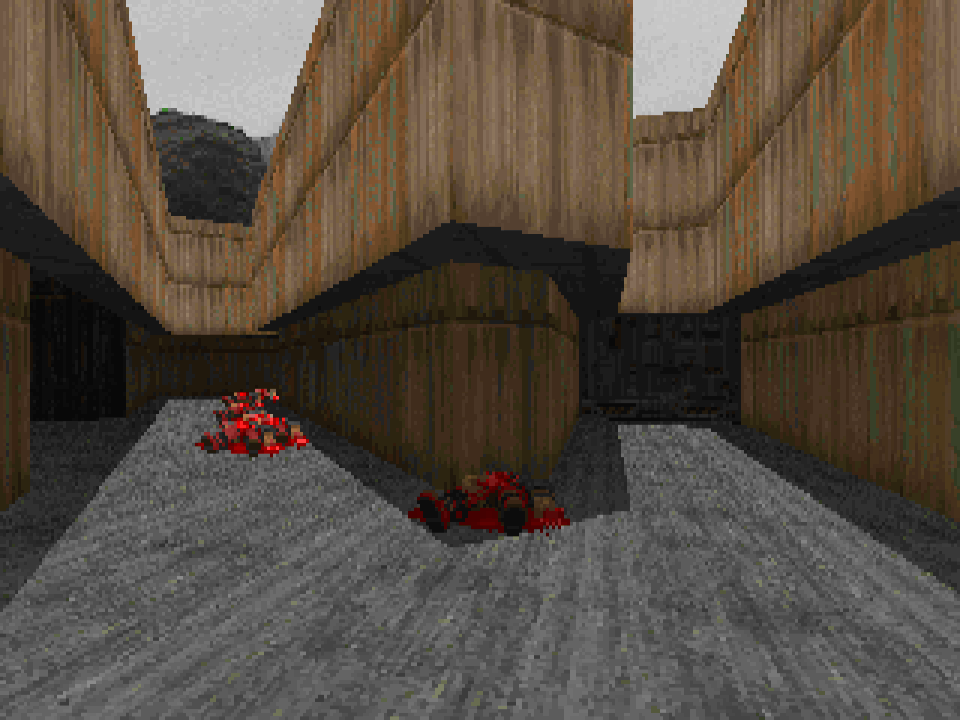
Episode 1 (Knee Deep In The Dead) was a kind of lonely computer base. The buildings are mostly all a sandy brown color. They’re nice little monuments to scientific progress that feel like a cohesive unit. They also aren’t too grimy - the places look like they were only recently abandoned and therefore are actually kinda pleasant, aside from all the enemies. The outside is pretty in a distant world sort of way, with a bright sky and a big mysterious mountain looming in the background. As the levels progress, their friendliness dissipates and they start to turn into twisting mazes of confusion. Level 6 (Central Processing) and level 7 (Computer Station) are non-linear nightmares filled with traps. I don’t find either particularly pleasurable to play because of that. There’s a curve ball at the end, an anticlimactic eighth level that starts off epic but quickly turns into a teaser to I guess to give people who played it as a shareware episode a taste of what was to come.
Episode 2 (The Shores of Hell, my favorite) is like a more mysterious and darker cousin to episode 1’s ethereal science bases. The levels look long abandoned, maybe where the more morally questionable experiments were carried out. Teleporters are more frequent and disorienting, which probably made a lot of people at the time nauseous. At least a few of the levels have this organically overgrown feel in a Stalker-ish way, like monsters took them over into a strange sort of ecosystem. The sometimes disorienting layout makes them have almost their own internal laws and logic, like some kind of Zone. Level 4 (Deimos Lab) is my favorite DOOM level, it’s fairly linear but also very open and mysterious. It starts off low-lit and foreboding, but after the initial areas the the level closes in and takes you on some kind demented ride and reveals something important in the end (that wall of faces is like some kind of scary catharsis). Level 6 (Halls of the Damned) has an amazingly appropriate name, because the dark mazy layout is so intensely claustrophobic. Level 7 (Spawning Vats) is a brilliant non-linear amalgamation of everything in the episode. It’s like a condensed, kaleidoscopic re-experiencing of everything you've been through once before.
Episode 3 (Inferno) is just straight-up hell filled with strange, incomprehensible, inconsistent, chaotic architecture far beyond any sort of human comprehension or logic. The entire episode plays like one gigantic wall of wailing faces. I was scared to play it as a kid, but also found it strangely fascinating and sort of wildly cartoonish, gory way. I know now from lurking around DOOM communities that a lot of the character of the episode has to do with designer Sandy Petersen’s odd texturing and layout choices, but when I was a kid I didn’t know anything about what good level design or texturing was supposed to be. At least a few of those levels do things that might be frowned on now, but they work wonderfully within the context of the game. Level 6 (Mount Erebus) in particular is very unconventional. The name is a reference to a Lovecraft story with an ominous mountain in South America, but the actual level is bright and wildly over the top in an exhilarating way (and much much better than some of the similar levels in DOOM 2). By contrast, level 7 (Limbo) is elegant, restrained, mysterious and somber (despite a puzzlingly blue ceiling). It so perfectly fits the theme of being in the place between heaven and hell, and is so fully realized and complete that it gives me a feeling of joy to think about it.
Episode 4 (Thy Flesh Consumed) I had because I owned the CD version of DOOM. It’s really much more intimidating and effective than Episode 3. The levels have menacing names all taken from Bible verses. The layouts are so complex and huge and even though I played with invincibility on I wouldn’t play the episode because I got scared by the amount of monsters. the design is just pure chaos, it often makes clear to you that there are forces beyond your own manipulating you (especially in the first level). The architecture is less outright strange and just more epic and subtly upsetting. It sheds the over the top gore and embraces a restrained,intense malevolence. The levels have a peculiar difficultly curve, starting out insanely difficult and then ending fairly easy. At least, after level 6 (Against Thee Wickedly), the heart of darkness. By that point in the episode your spirit is pretty thoroughly crushed. You’re still in some kind of other terrible universe with a perpetually orange sky, but at least taking a break from the claustrophobia of the level before. The rock outcroppings are pretty simple and appear to offer some sort of relief, but once you descend far enough there’s the outline to part of a marble castle. This castle is like stumbling on some sort of lost palace. It’s cruel in an ancient civilization with ancient values sort of way. There’s large pit of toxic despair in the middle (echoing e4l2), that only exit out are tiny elevators on the walls of a small structure in the middle of the pit that send you to teleporters. The level will wear down your soul. It makes you continually grind up and down that pit of despair, finally fighting a cyberdemon at the throne and escaping out the other side. It’s truly a chore to get through, one that makes me feel like I’ve just walked in and out of some truly dark and scary place.
By the time I was done with DOOM it left an indelible mark on my psyche. It was serious, and it was real. It wasn’t a game to me, it was something else... maybe you could call it an “alternate experience”.
Subscribe to:
Comments (Atom)