 |
| note: this is an edited/updated version of a talk i gave at Indiecade East in 2015 |
the events we gather in and the communities we work in, no matter how much we stretch and pull at their boundaries, are still all built around this ideal of games as some kind of super-medium, a kind of Eden or great pyramid that once we find the sacred formula to or reach the top of we'll solve the problems of all culture.
which is why we need diversity and new voices speaking out, right? it's about bringing all new ideas under the umbrella of this - the latest and greatest medium - the medium of the 21st century.
forget about us as individuals, we're all sacrifices on this great altar of "improving games".
this is the same kind of religious devotion to an idealized vision, by the way, that gamergaters will regularly employ to explain the motivation for their own actions.
and we know that, despite how much we try and push and pull at it, an event like Indiecade East is built around this ideal because that's what keeps games culture running, and the money and interest flowing. events like this predicated on preserving some kind of status quo by keeping us all under the umbrella of game culture - something that is profitable.
and that's not to say that an event like this doesn't provide us with a kind of community and a structure, and an audience to engage with that we might not have otherwise. that's what there being money around games does. but it's also self-destructive at the same time, because it breeds a very insular, closed-off way of talking and thinking about what we make - and it ensures we won't reach an outside audience.
which is why i'm taking this invitation to just say fuck all of this and try and broaden the conversation outside of games. maybe it's not worth trying to embark on this from inside the umbrella of a game conference - a place i'm assured will not reach an audience outside of games. but it's worth doing anyway, i think.
++++++++++++++
 |
| Coltan |
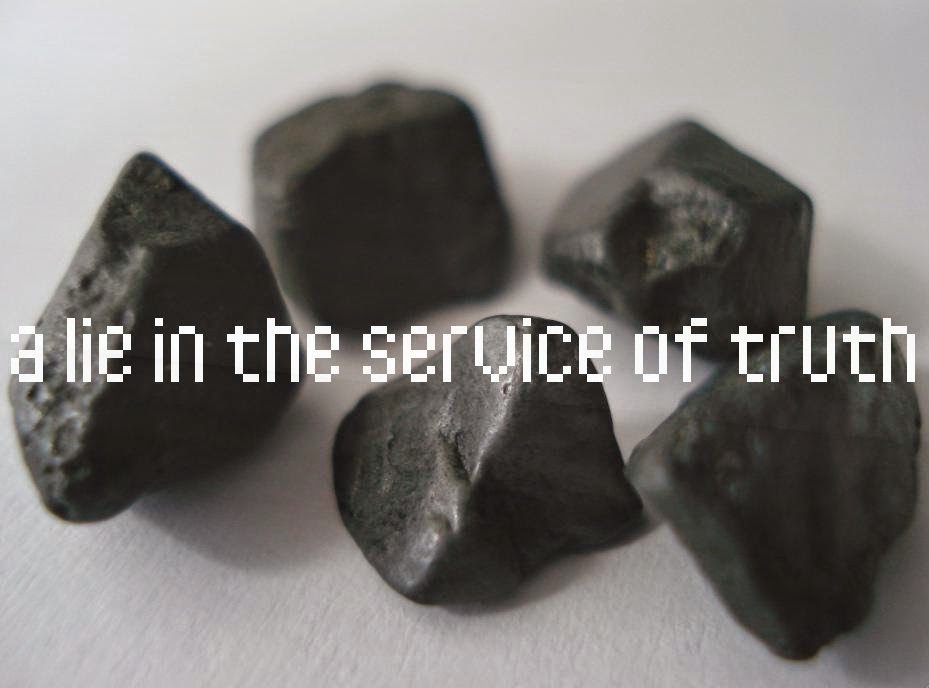
one of the big minerals used in the PS2 and other electronics is called Coltan. a vast majority of which was mined in the Democratic Republic of the Congo. from: https://conflictmineral.wordpress.com/the-playstation-war/:
Tantalum—mined as coltan and an integral part of cell phones and Playstations–found itself in short demand, and the price skyrocketed ten-fold overnight. The “coltan rush” in DRC lead to a vicious fight for control over the mines, and the “black gold” they held. Farmers near coltan regions were forcibly driven from their lands, villages were brutally attacked, women raped, and thousands displaced. Those not forced to mine by the militia were expected to handover part or all of their payload coltan as a form of payment.
It’s estimated that as much as $20 million a month went to rebel groups to finance war efforts.
...Both the forced production of coltan, and the military power created through its production, would wreak havoc on the Congolese people.
;;;;
it's not too hard to trace the demand for cheap consumer products to civil war and environmental devastation. but in the case of computers and other consumer electronics, it speaks to intense contradictions many of us are living out right now - where easy access to all kinds of tools thanks to ever-present digital media is allowing many groups of people who were voiceless before outlets to engage and be heard publicly. but it comes at the expense of submitting ourselves to these commodities (in the form of consumer electronics) that we get to have no engagement with how they're made or where they come from.
...and these are built from the blood of people who don't get to have the level of engagement with these products that we have (if they have any at all).
 |
| from: https://conflictmineral.wordpress.com/the-playstation-war/ |
but also, we look at images like this. how do we even look at images like this anymore? there might have been a point when these sort of images held an enormous amount of power to change minds, but now no one seems to know what to feel.
for one, it's a very clear testament the everyday human reality that comes from war. it's abundantly clear just from looking at it what kind of sadness this woman is experiencing. how exhausting and endless this kind of devastation is on people who have to live it. how hopeless it is.
in itself, that should be powerful enough to get us to start understanding and empathizing with the end result of our demand for cheap consumer products. but the problem is we've already seen so many images like these, de-contextualized, just in everyday life.
instead of looking at its face we just see an abstract idea when we look at it, or look at it defensively as if it is directly accusing us. a deep truth falls apart into a fragmented world of subjectivity and relativity. we come up with our own justifications for why this has to happen, or throw up our hands and say "well, what can we really do?"
and so even an image as powerful of this falls under the weight of a culture filled with feelings of confusion and disempowerment, inundated with other horrible images of suffering and destruction. and these are endlessly warped, repurposed, remixed, rearranged, reassembled to fit an incredible amount of purposes and ideologies. and they can become a meme and then lose a lot of their original context.
i think this speaks to a sort of failure of film in the 20th century - we thought that if we captured the image, straight, as it is (like in this image), then it would change people's minds: that a kind of documentary realness could strip everything away so that people would see behind the mask into the ugliness, and all its complexities.
there's a famous quote from Jean-Luc Godard, from his film La Petite Soldat: “To photograph a face is to photograph the soul behind it. Photography is the truth. And the cinema is the truth 24 times a second.” it's a hopeful, idealistic sentiment that captures much of the strivings of social realist art in the 20th century; that a thing like a soul is inherently captured in the technological medium. through this act of capturing reality as, we can see the truth.
what maybe speaks more to truth is in Michael Haneke's quote "film is 24 lies per second at the service of truth". because technology is a filter. it only presents us with one machine snapshot of a moment, not the entirety of it. and so what we think of as the actual, documentary truth as depicted by the camera might actually be much less fundamentally real than a subjectively depicted one that incorporates what is silently omitted from a "realistic" depiction.
 |
| Credit: Jesse Kanda |
it might seem terrifying that, through technology, we can never approach capturing the real truth of a moment. we fear that technology always makes truths wither away into relativity. but i think this ability to warp, and rearrange, and reassemble endlessly, instead of being a terrifying new distortion of the human psyche, can actually help us delve into much greater and deeper truths and realities than straight photographic depiction ever could. that layer of abstraction affords us a freedom we are often afraid to embrace. but i think, through embracing it, we find much more creative and expressive outlets to describe the truth of our situations.
digital media is inherently good at capturing the fragmented nature of our reality and spitting it back out as something we might not have ever considered before.
/////////////////////

in the San Francisco Bay Area, the arts are not infrastructurally supported. one of the reasons why is that the wealth is mostly comes towards young people employed by the tech industry, who don't feel the same sort of obligation to fund or support the arts as people in other sectors of business do. old wealth in places like NYC often carries material goods or creative treasures as a status symbol. being a patron and supporting the arts is part of that culture. but in the Bay Area, that patronage is much less present. investing is seen as an entrepreneurial. everything's worth is gauged by how much measurable gain it can bring its investor.
this is from a piece titled "The Bacon-Wrapped Economy" by Ellen Cushing:
if the old conception of art and philanthropy was about, essentially, building a civilization — about funding institutions without expecting anything in return, simply because they present an inherent, sometimes ineffable, sometimes free market-defying value to society, present and future, because they help us understand ourselves and our world in a way that can occasionally transcend popular opinion— the new one is, for better or for worse, about voting with your dollars.
even through sites that try a patronage model like Patreon - which basically pays my rent and paid my ability to come talk at Indiecade East, by the way - you're not really investing to improve an institution or for social good, but you're investing a little bit in someone's work to see some material gain in the work they produce. even if the material is not swag-like bonus items but simply allowing the artist produce more work, the way the service feels more like a marketplace and a kickstarter-style consumer investment model than any kind of institution or community-building one. it's no surprise that many of the most successful users on Patreon have rewards systems for their supporters very similar to kickstarter. there are still implicit rules in place that come from the default mode of operation of a tech business model like this being within consumer culture.
i think this is because the language of consumer culture is what my generation feels most comfortable within. it's easier to sell the idea of patronage when it follows an already-established model. but i also think it's in part because tech believes they're already doing the work of providing the masses with powerful tools free of charge. it's only a matter of finding the ideal system, to make good aggregaters and provide tools where the best and most interesting things will rise to the top. everyone is theoretically on a level playing field, so there's no need for individuals to mediate.
but of course this is built from the great faith that tech places on "meritocracy". because art in these systems is seen only from the angle of how much measurable gain it can bring its investors, from audience numbers, to advertisers, to dollars. instead of some kind of higher-minded ideal of societal good, what comes is a massive reinforcement of the status quo throughout all channels. and so anyone who participates in a site like Patreon is expected to follow the model of its most successful users in order to find funding; the ones who tend to offer more consumer-friendly, middle of the road, unchallenging product. there is no institutional interest in users who might make bring less money to Patreon through more challenging or hard-to-sell work but might affect a vastly greater social good. artists hoping to challenge their audiences are simply not supported in this model.
this is frustrating partly because there is a history within consumer tech companies providing more holistic and powerful tools to artists - tools which often have now been laid dormant or actively suppressed because they don't fit in with the current "closed box"-style tech business philosophy.
i think the killing of Hypercard illustrates a lot of the hypocrisy about art at the heart of tech culture.
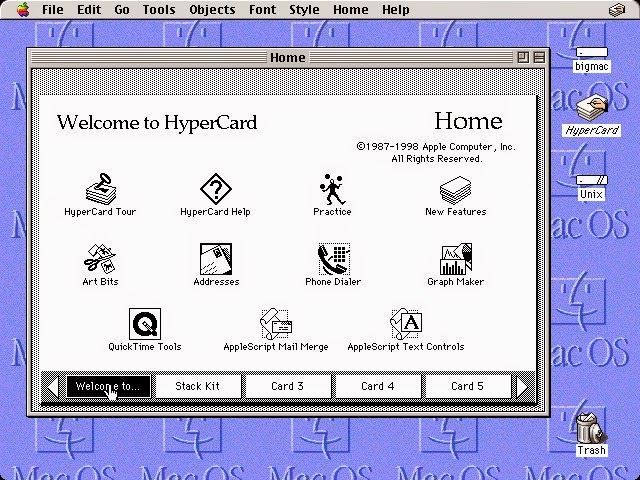
Hypercard was a programming tool for Apple computers in the late 80's and 90's. it was a bit like Twine in how it made programming accessible, except it was more visual and intuitive.
it was also, to be honest, much more powerful than Twine. Hypercard was well integrated with the Mac, it was full-featured, and its interface was much less piecemeal and clunky than something like Twine. it was as if Apple actively had an interest in making it as simple as possible for its users to look inside the computer and learn something new about how they work. some games you might have played - like Myst, were made with the backbone of Hypercard. yet nothing like it has been well-supported or embraced since then.
from an essay called "Why Hypercard Had to Die":
HyperCard is an echo of a different world. One where the distinction between the “use” and “programming” of a computer has been weakened and awaits near-total erasure. A world where the personal computer is a mind-amplifier, and not merely an expensive video telephone. A world in which Apple’s walled garden aesthetic has no place.
...(When Steve Jobs came back to Apple)...He returned the company to its original vision: the personal computer as a consumer appliance, a black box enforcing a very traditional relationship between the vendor and the purchaser.
((((((((((((()))))))))))))
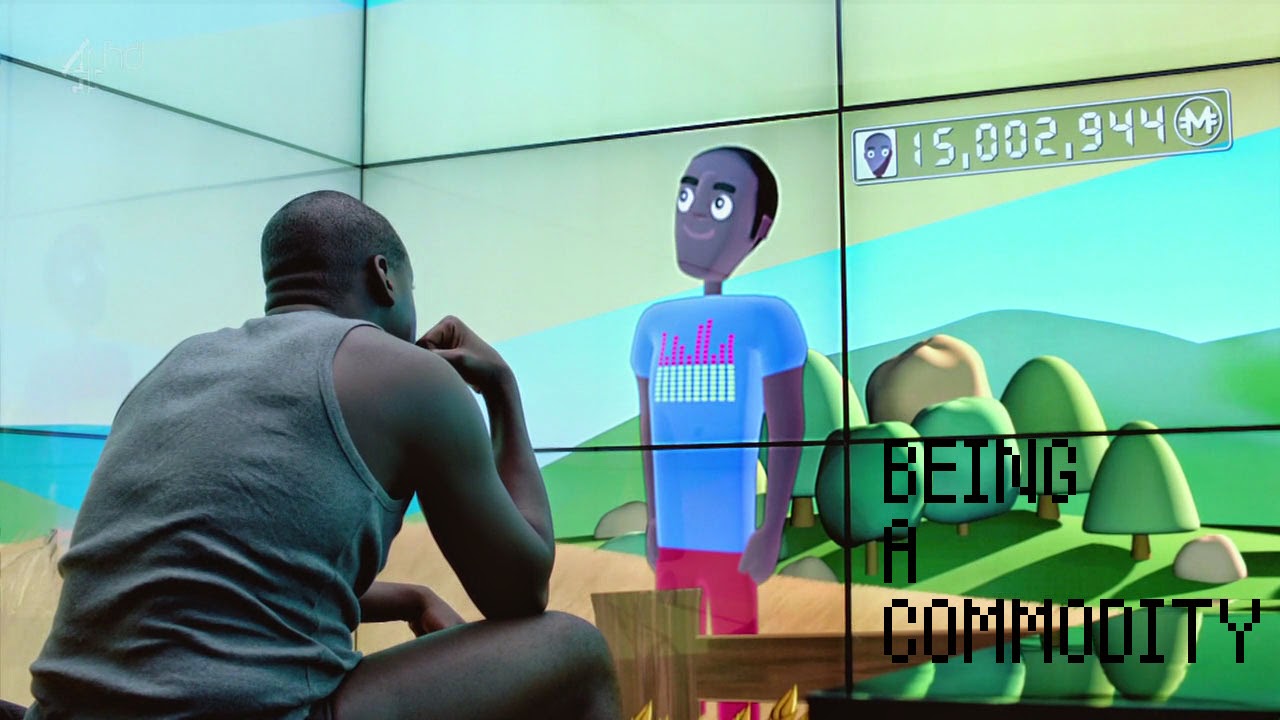 |
| Black Mirror S1E2: Fifty Million Merits |
in the 90's and earlier, the internet was often a place to practice your own identity how you saw fit and define yourself away from the confines of society (though admittedly only to those who could afford it and fit within active subcultures). even with all the changes that have happened to the internet over the years, in a way this has never completely gone away - but it's been increasingly colonized by advertising and business interests.
twitter you're leasing your personality, your brand out to other people to consume. and a lot of communities not traditionally supported within technology's culture have had a much greater influence on cultural discussions in recent years because of it. still, in every part of those discussions with friends and foes, you're being aggregated, and mediated by advertisers. these are super powerful tool for letting you get products that you like the fastest. and it's a super powerful tool of tracing popular trends and then finding ways to monetize them.
there's a lot of emphasis on networks like twitter or tumblr, at least in less professional spheres, about you being yourself and expressing yourself.
on facebook, you and your friends and your personal info become commodities and spaces that can be leveraged and leased by corporate interests looking to get in on your personal space. that's the way huge business interests are able to support and sustain it. most people are aware of this and will accept this for the benefit it provides you with connecting a vast network of active users, but the design of these networks also bring with them less apparent downsides to how that connection takes place.
these spaces are made to feel equal, and egalitarian, and usable - but they're not equal. there are many barriers put into place under the bland surface.
for one, we don't really get to define how interactions happen on these networks. on facebook, we're pushed to use our "real name" or else face deletion, and we're socially pressured into to using it as a space to have fairly shallow interactions with friends and co-workers. on twitter we can only have discussions split in 140 character bursts, and there are few effective tools for dealing with harassment. on tumblr, we can only reblog a post to comment on it, ensuring that substantial continued discussion gets bogged down and lost in the clunkiness of its reply system.
and marginalized people trying to connect with people or build communities are at huge risk being overtaken by toxicity. where there is little regulation, the loudest and most aggressive voices tend to take over and make spaces unsafe. people looking to use this chaos as a convenient platform to throw other members of those communities under the bus and spring themselves forwards are empowered. we've seen time and time again how much communities reinforce oppressive ideas within themselves, the question is how do we change it?
of course solidarity is important, but not everyone is coming into it with equal footing. there's been a lot of talk about intersectionality, but more than ever we see how crucial it is to have a more universal and flexible framework for empowering people that doesn't lie in our own individual biases. of course, the current way of connecting and organizing has its advantages but it doesn't leave any systems in place to lay down more longer term; or more abstract, less directly confrontational ways of addressing issues.
this is why reclaiming these spaces, and redefining the structures built into social media is more of an art than a science. because we are not equal footing, it necessitates creativity and different strategies. and it necessitates being acutely aware of their shortcomings.
honestly, it's a huge testament to the human spirit that we find new ways to relate each other and organize in the midst of these frameworks that are almost certainly not designed for it. movements like the Arab Spring, or Occupy, or the recent Black Lives Matter protests would have never taken off if not for twitter's ability to spread decentralized information very quickly to a huge amount of users.
i seriously doubt this was intention on the part of twitter. right now the digital realm is kind of a wild fight between the efforts to control and regulate the amount of power we are able to exert as users online on these networks vs. corporate powers tightly being able to mediate our interactions. and i think this speaks to the disingenuous way the tech industry uses the image and philosophy of its libertarian, open technology roots while also engaging in an active an effort to close the box and make online spaces into walled gardens.
the recent heartbleed bug was such massive problem because the openSSL framework that google and other companies depend upon is open-source and maintained for free. google doesn't use their resources to pay people to maintain it - they depend on free labor for people to do it for them. had they paid their own people, maybe there wouldn't be such a massive security hole.
[[[[[[[[[[[[[[[[[[]]]]]]]]]]]]]]]]]
i wanna talk about something else that's been on my mind.
i have a tumblr where i post screenshots of odd videogame worlds (which is not very active anymore, sadly) and through that i discovered some people who were more committed to and better at finding and curating strange cultural ephemera than me: ulan-bator and fm towns marty (among others). the games they post from are often not in English and on computers that are not widely used or supported anymore. these are ephemera that might not be preserved on the internet otherwise.
a couple of years ago a video (NSFW) by a fairly well-known video artist named John Rafman came out for a Oneohtrix Point Never track used a lot of images from fm towns marty's blog without any credit.
this is the response from fellow videogame curator ulan-bator (bold mine):
fmtownsmarty has been doing what he does for years — finding games that most people don’t give a second thought, playing through them despite of obscure outdated technology and language barriers, and presenting them in an original way, with intelligence, integrity and humour. ...
Then comes this fucker “artist” and cherrypicks his tumblr, juxtaposes it with stock internet shock imagery, presenting it on 4chan since I guess maybe he subconsciously realizes that’s about the level he’s working on. Of course 4chan thinks it’s really deep, cementing the impression of most people who don’t know where the actual effort involved comes from. Jon Rafman presents his work as gathering imagery from various fetish and videogame-sites on the internet, at first not mentioning any names. Noticably, the bits giving his video any structure, the final shot of the video which leaves the watcher thinking maybe some thought went into this video, and which in turn tumblr users have screencapped to yet again make gifs of, all come from fmtownsmarty.tumblr.com.
When fmtownsmarty gives Jon Rafman a hint that maybe what’s happened here isn’t all as it should be, he gets a nondescript link in the description on vimeo to his imgur account, neglecting to link to his tumblr where he’s been exposed for ripping off fmtownsmarty’s work, neglecting to say anything about the extent of his “work” that actually comes from fmtownsmarty. Of course Jon Rafman gets seen as a pioneering artist for his slumming in internet culture, much like artists in the past have been “pioneering” for slumming in street art culture or “primitive” culture.
of course some tumblr image blogs are not equivalent to grassroots cultures, but the same dynamic is there. it's important to emphasize that re-appropriation which comes from the top down is not the same as what comes from the bottom up.
so i feel like there's this sort of dichotomy: of new media sprung up from this libertarian promise of freedom on digital spheres, where more people than ever before have access to tools and methods of distribution than they ever would have. but it's also where the spaces are largely unregulated by a larger ideal, and where work that tries escape the bounds mediated by consumer culture that forms the basis of this generation's way of thinking about creative work tends to be intensely marginalized.
and then there's the institutionally-sponsored art world, where art made outside the bounds of consumer culture is supported and there is a kind of civility and sense of mutual respect that comes from interacting in person with people. but it's a world that's crumbling. the kind of breadth or class involvement that these new forms of art might be integrating aren't respected, nor are they seen as relevant. this world must rely on sucking ideas out of these new media and new communities to keep their blood running - and often only do so in a surface, disdainful - classist and racist way.
this dynamic is nothing new, of course, but the form it takes now is a bit different this time. i call this dynamic "the wolf vs. the vampire".
these days, when you're making art in the digital realm, especially new or less-explored kinds of media, it often feels like there's no way to win. institutions will only support your work if you speak to their language or culture. and sub-communities on the internet are designed so that you have to shape yourself to fit into whatever the values of whatever subcultures that exist for them to accept or understand it.
i think a lot of work made today, especially in games, is defined by that dilemma.
the problem is often we expect these systems to mediate and solve problems for us, when in fact there is no easy way out - because it was never built into the system. if we want to envision a way out of this binary, we have to find ways to very intentionally go against the structure of our usual support systems to create one. but when we are provided with a basic level of support, it's hard to want to go against the source of that support and risk your livelihood, audience, and social sphere..
but then, of course, there are people who have nothing.
;;;;;;;;;;;;;;;;;;;;;;;;;;;;;;;;
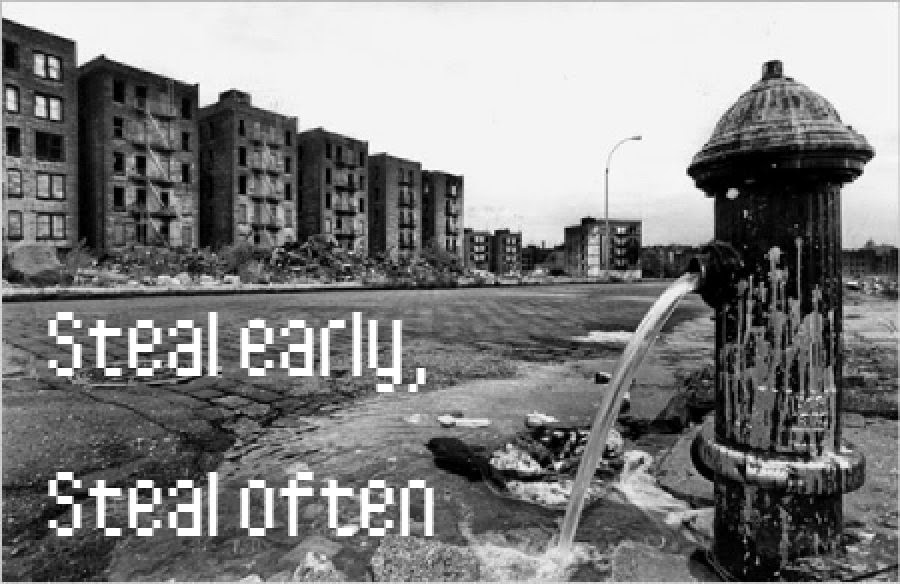 |
| South Bronx in the 1970's |
breakdancing and turn-tabling are kind of seen as media cliches now, but they came out of this culture. when we see them now, we see the image of them decontextualized, as if they are and were always media fabrications. we forgot that these are things that came out of people trying to create something positive from intense limitations from the environment they were in. we forget they come out of poverty, violence, and racism. we see the product that comes out of the struggle, but not the struggle itself. the act of extracting a product from oppression and then selling it back to people is what capitalism is intensely good at doing.
so, several steps down the line we have the abstract philosophy of empty materialism often espoused by popular rappers; one that is universal and aspirational for young black kids wanting to escape the same old cycles of poverty and violence, but also has a bizarre cartoon grandiosity that takes power away from communities. when these kids are inundated with images of rappers who've made it, the idea of making the best of what you have seems like nothing in comparison the prospect of larger fame, however small. this, in turn opens it's way for homogeneity and an inability to evolve outside the same toxic ideas. Questlove talks some about this in his series "How Hip-Hop Failed Black America"
but in making this critique, however apt, we risk missing out of the positive outcomes of this culture. how it addressed poverty, brutality, and racism in new and clever ways. in a way, i think the full context frees us by allowing us to move past seeing only the failures of a particular culture. if we look at the past as an opportunity for renewal rather than a static gravestone, we can use it to help us in the present.
hip-hop was intensely resourceful. in lieu of nothing else to power their sound systems, d.j.'s for outdoor block parties in the 70's would power their shows by tapping into the power from street lamps.
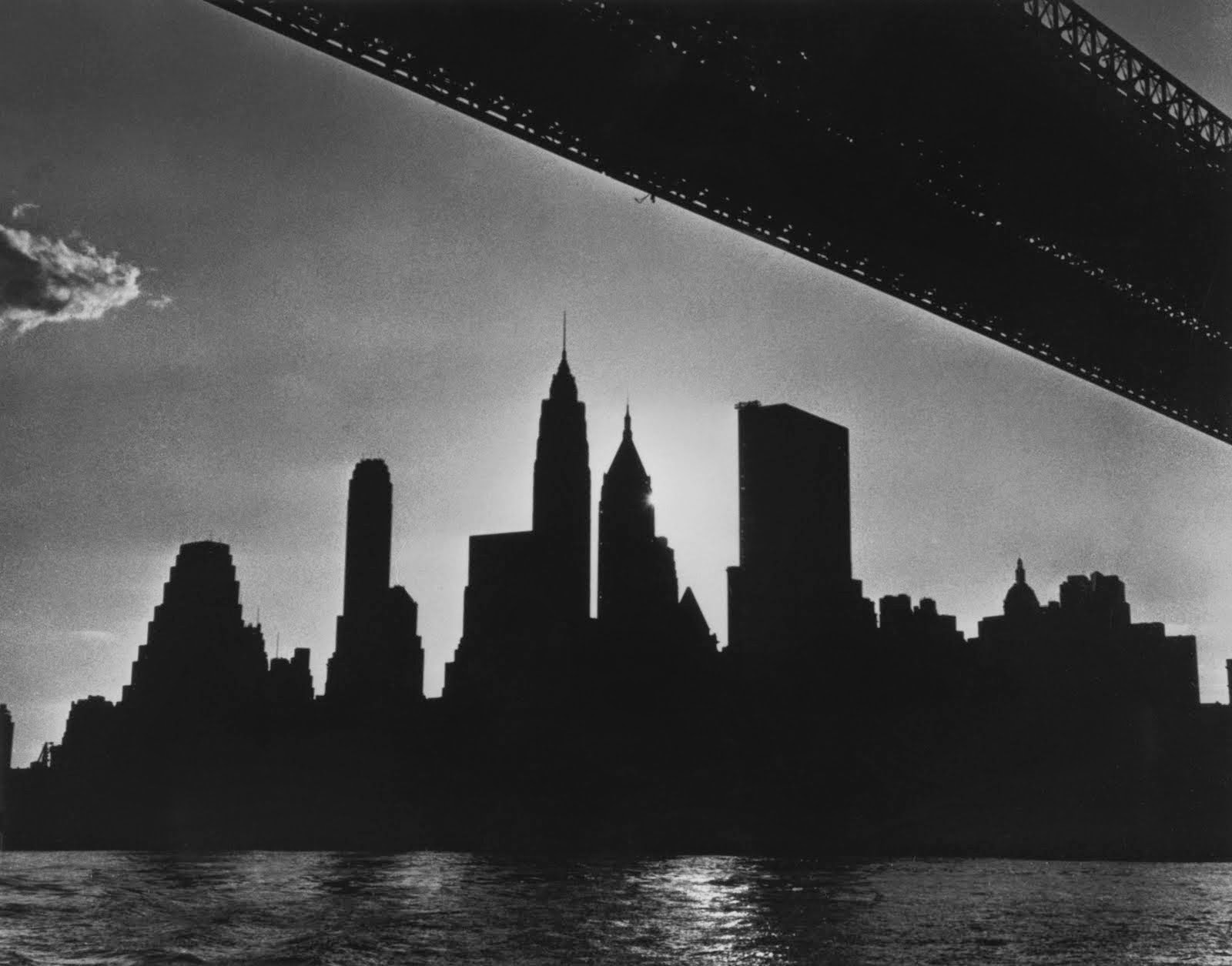
but the biggest moment is during the NYC blackout in 1977.
 |
| NYC blackout |
During the blackout, a number of looters stole DJ equipment from electronics stores. As a result, the hip hop genre, barely known outside of the Bronx at the time, grew at an astounding rate from 1977 onward.
"It was like Christmas for black people... The next day there were a thousand new D.J.'s." - Curtis Fisher aka Grandmaster Caz
in systems built around absolute unfairness, it makes sense that a thing like piracy becomes the great equalizer.
i think it's more obvious than ever now that things that are put out there in the world are going to be re-appropriated, re-purposed and remixed. in the age of easy access to tools and easy distribution, it's something we can do readily and with ease. regardless of whatever judgment you'd like to put on that, it's something that happens and will continue to happen.
where all barriers have been broken down between discrete forms of media - where games become novels become visual art become films become music, and back again, the rules are different than they were before. and making any sense of these new rules might be difficult, but it's also tremendously exciting. because the technology any user has is so powerful, there is literally no way to control and mediate what comes out of it. the realm of the digital is a virtual playground for anyone who can harvest its power.
but as we've seen, cultural change doesn't come from the top down. it doesn't come from venture capital, or non-profits, or particularly insightful talks at conferences. it doesn't come from a particularly well-built systems (which inevitably reinforce existing power structures). it comes from community. it comes from organization. it comes from reappropriation. it comes from chaos, strife, and struggle. it comes from changing the context, and the way that we think about and communicate with each other, and how we have discussions. it comes from the bottom up.
....☀❁★_★❁☀....